
Here is something you may not have known about the Baja Peninsula: several black holes line its shores. They exert a tremendous gravitational force upon boaters who venture too close. La Paz was the first such phenomena we encountered, although we did not recognize it until we had finally shaken loose. But all the signs were plainly there to see, including cheap beer, amazing fish taco street stands, and wandering packs of ex-boaters who may live in houses ashore but still participate daily in the morning radio net for cruisers. While in La Paz, we benefitted from local knowledge generously shared by these ensnared former cruisers, but couldn’t imagine ourselves ever getting stuck in one place for so very long. . . However, on the third provisioning trek we got the sense that something else was happening, for already it had been two weeks and still we were not through with La Paz! Or rather more darkly, La Paz was not finished with us.
We eventually did tear free from the swirling eddies, and got away before permanently changing our address. Unbeknownst to us, another hazard lay ahead, and the sailors call it the Hidden Harbor.
Our memories of the black hole mysteriously erased, several weeks later we left a different anchorage and headed for Puerto Escondido, all three sails flying brightly on a northerly reach. We were anticipating using the harbor as a base station, from where we could catch a ride to nearby Loreto for some internet time, groceries, and a meal away from the boat. Indeed, all of that came to pass, although so strong is the pull of these coastal black holes that we nearly got yanked through the hidden harbor of Puerto Escondido and spit back out in La Paz, a la Star Trek. But I jump ahead in my story.
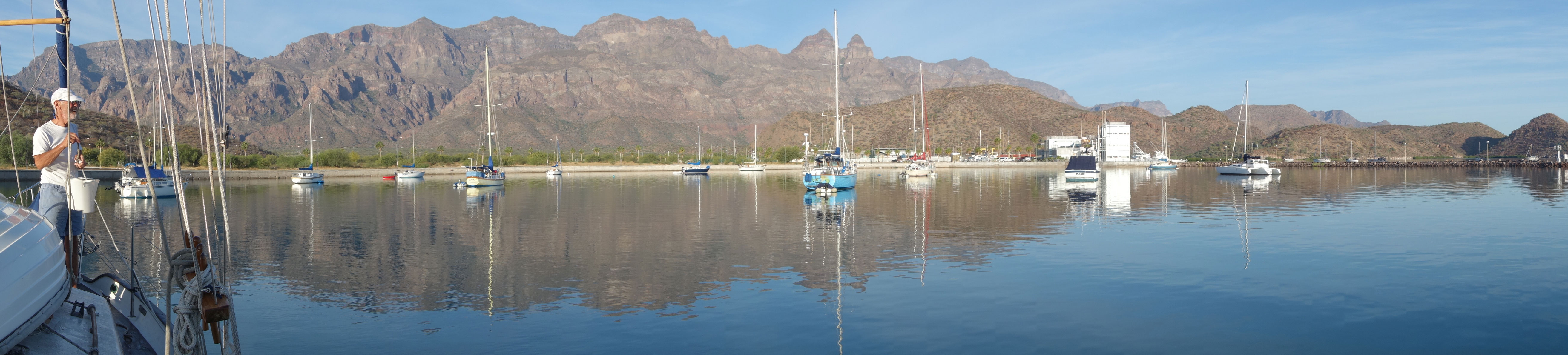
Panoramic view of Puerto Escondido. We are anchored in the Ellipse; the Waiting Room is out of sight behind us; the multi-story buildings are the marina office, laundy, Pedro’s cantina, and mini-super grocery; entrance to the main harbor is through the channel on the far right.
The first indication that anything is amiss comes when you enter the first of the three anchorages in Puerto Escondido. It is called the ‘Waiting Room,’ because in the old days, one would drop the anchor there while waiting for a spot to open up further inside the harbor. Now, however, the Waiting Room is so full of boats waiting, but which seldom leave, that when we were motoring around trying to find a spot, one of the owners came out in their dingy and explained to us that all the boats there were now on permanent moorings, and so there was no room to anchor. He was so friendly, so helpful. Perhaps we could try the ‘Ellipse,’ the second of the three anchorages.
The Ellipse is a concrete-ringed pool with about ten boats on moorings, and room for maybe 2 or 3 boats to anchor on the outer edge of the pond, nearly in the tidal channel. We looked at each other in horror, memories of La Paz rushing back. We were voluntarily entering another black hole. But we dropped our anchor anyway, reasoning that we only needed to be there for a little while.
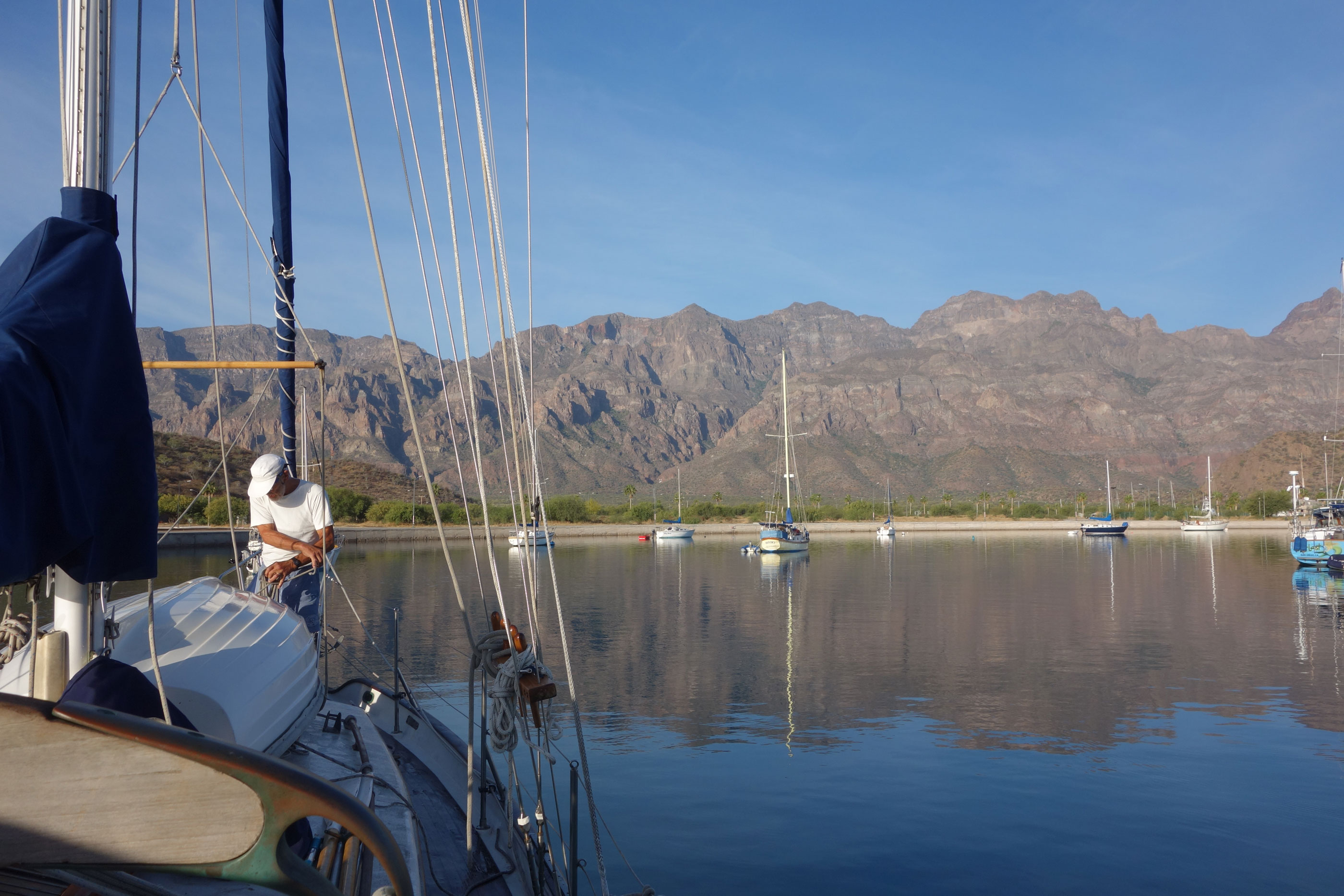
Getting the dinghy ready to launch, anchored in the Ellipse.
After two days of trying unsuccessfully to find a ride into town, we pulled out and motored to Loreto. There, we dropped anchor in the open sea outside the too-shallow marina. It was so rough that Carla had to stay on the boat in case it broke loose, so Wade rowed ashore alone for his dental appointment. After a successful tooth re-attachment, he got some groceries and returned to Pelican Moon in rowdy seas. We managed to get the dinghy back onboard without breaking anything, and sailed across the four-mile wide channel to anchor at Isla Carmen for a few days. Rationalizing that we both wanted to visit the historic town of Loreto together, we then returned to Puerto Escondido. When generously offered the free use of a permanent mooring in the Waiting Room, we tried to ignore the lifelike tug from below as we attached our lines to the float and Pelican Moon dipped her bow to the buried concrete footing.
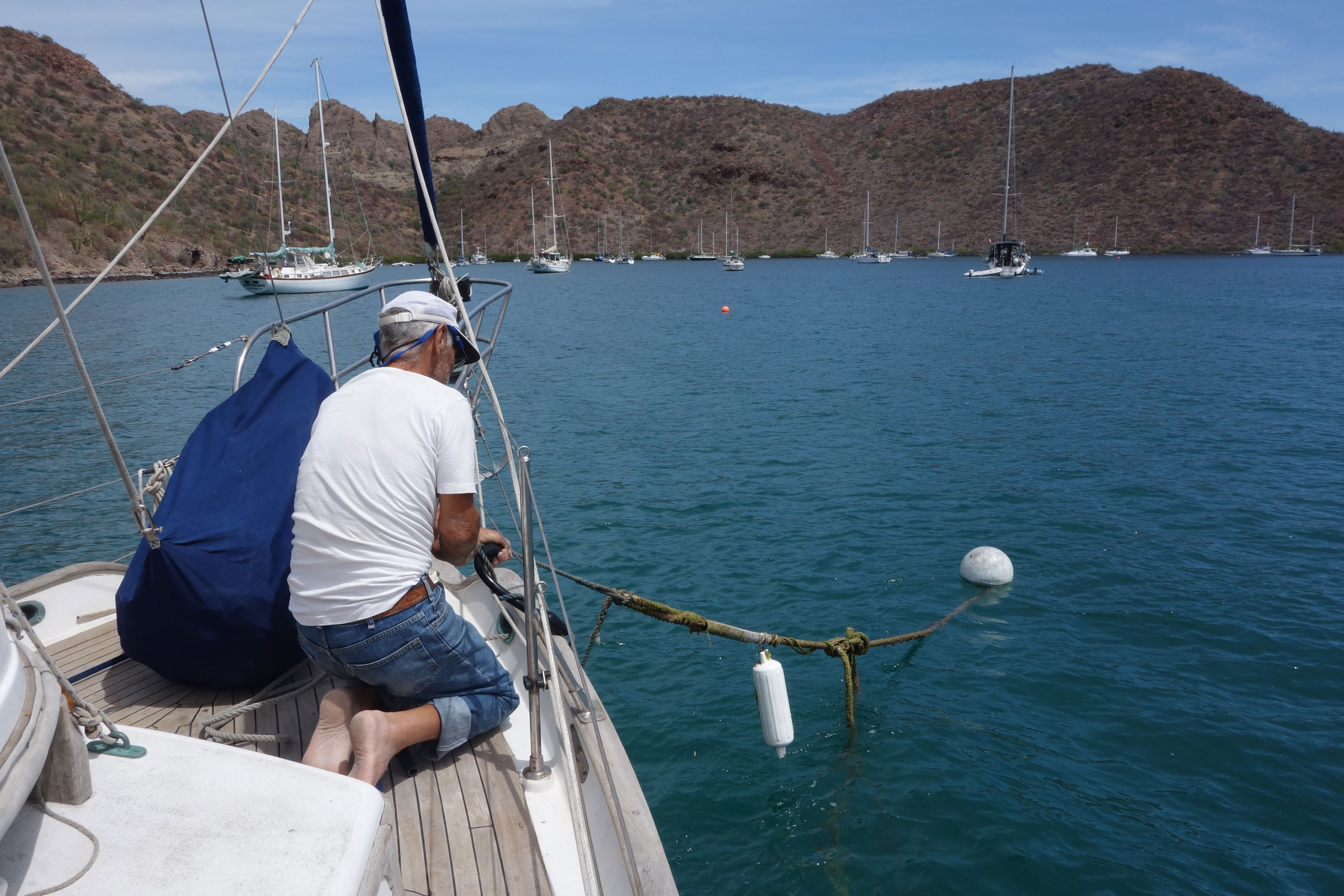
Checking the mooring lines in the Waiting Room.
The massive development at Puerto Escondido was designed and implemented by FONATUR, the federal trust fund for developing tourism. FONATUR has a reputation for building infrastructure ahead of demand, and Puerto Escondido has miles of paved roads slowly crumbling back into the desert, luxury condominiums half-built, unrepaired concrete docks broken into pieces by hurricanes years ago, offices, stores and bars that are open when convenient, not when posted, no hot water in the showers, no TP in the restrooms. But there is just enough money available to pay half wages to the remaining employees, who manage the marina and harbor affairs, who stand guard at the road entrance, keep the flowers watered, clean the grounds, paint the flagpoles and the palm trunks, rake the empty dirt lots and assist all the cruisers. Best of all, a certified diver has a business in one of the high rises, and black-holed boaters pay him to set up heavy concrete moorings for them in the Waiting Room and the Ellipse, which allow them to permanently avoid the main harbor, which FONATUR has mostly filled with official mooring balls, the use of which costs a pretty penny. But not very many pretty pennies flow into the federal coffers anymore, because who wants to pay for cold showers, or mooring balls whose anchors may drift when a stiff wind blows?
FONATUR also constructed a small marina inside the harbor, with room for about 15 boats, most of them large sportfishing yachts all spiny with downriggers, rod holders and fishfinder antennae. This is a good place for the rest of us to fill up with water and diesel, when you can find someone working, and if the dock tanks are full.
By far, we found the best part of Puerto Escondido to be the people. The employees of both FONATUR and the Port Authority were universally helpful and friendly. I admired the blouse of one woman at the small supply store, and she graciously improved my Spanish regarding the art of compliments in Mexico, with lots of laughter on both sides. Also residing in Puerto Escondidon are a salty bunch of predominantly expatriates who have willingly jumped feet first into the black hole lifestyle by tethering their boats to large pieces of concrete at the bottom of the anchorage. Most of them seem to stay nearly year-round. They are supplemented by many others who drift down on the northerlies to mainland Mexico for the winter and ride the southerlies back north in the spring, either to live in or leave their boats in Puerto Escondido for the summer. This darkly-tanned, rule-eschewing tribe of sun worshippers is held together by a morning radio get-together on VHF 22 sponsored by the Hidden Harbor Yacht Club, which has its clubhouse in the Port Authority building. By listening every morning at 8 am, we were able to find out how to get wherever and find whatever we needed. We could even barter for parts and other bilge debris that sounded useful. If we didn’t turn the radio off quickly enough, we were also treated to some of the most tasteless jokes you would never think to hear broadcast on a public channel.
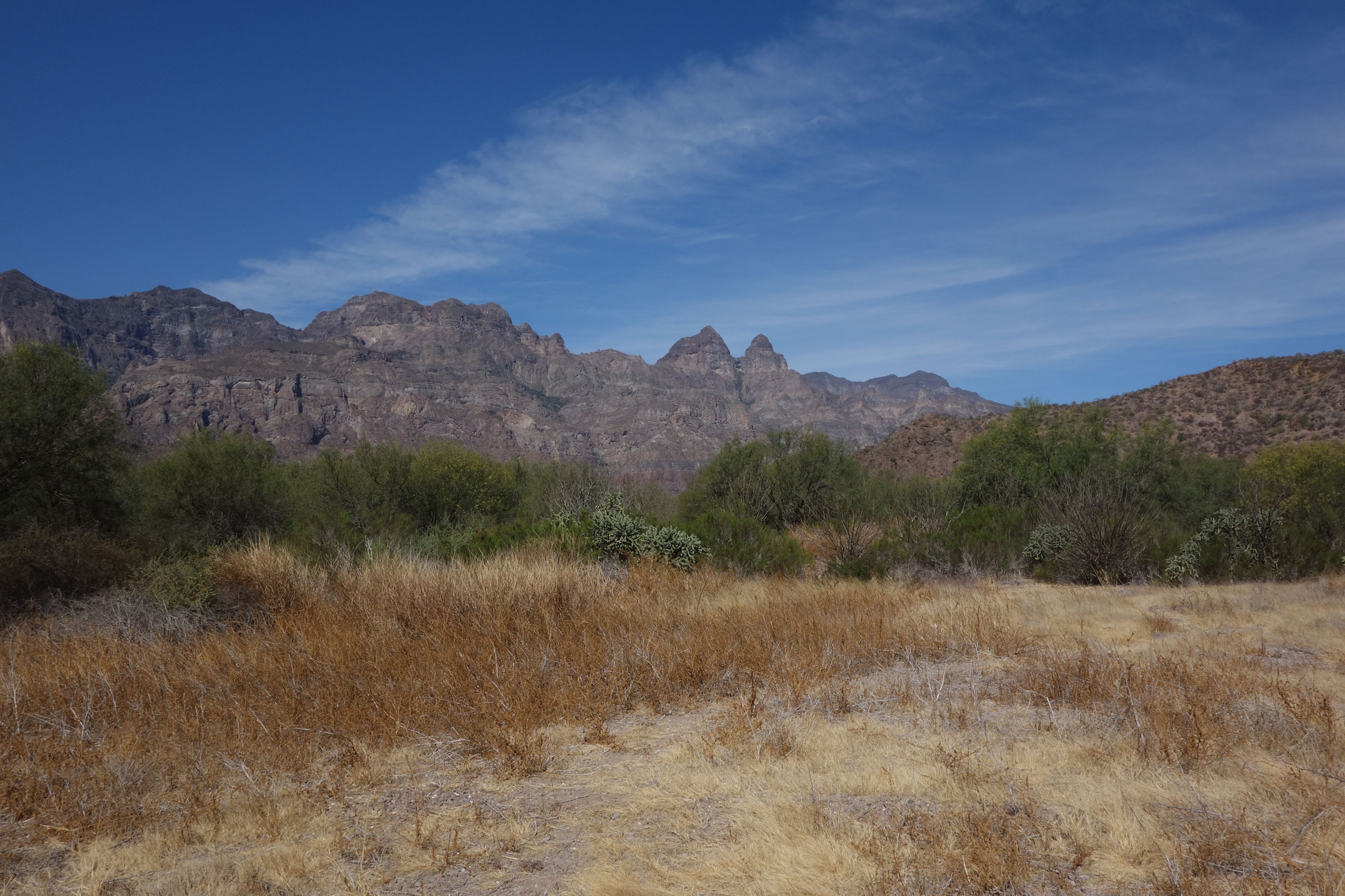
The scenery around Puerto Escondido is as beautiful as the development is weird.
Besides the VHF radio net and the friendly clubhouse, the other glue for this community is found upstairs in the FONATUR office complex, where a modern restaurant/bar lies welcoming under deep eaves, open to the harbor. This meeting place with comfy chairs and giant fans twirling overhead has good internet access, powerful drinks, tasty food and a charming owner/host named Pedro. He is fiftyish, tall and tanned, clad in polo shirt, crisp shorts and boat shoes. With wavy blond hair and an excellent command of English, he greets everyone who enters, embracing those he has known for more than a day, making jokes and offering commentary on the daily news, often breaking into a bit of song or a quick salsa riff when the 80s MTV loop on the big flat screen inspires. “Poco poquito,” or “little-by-little,” was his favorite catchphrase while we were there, and it covered everything from his gentle teaching of Spanish, to telling us when the food would arrive; from sharing stories of grandkids growing up, to general tales of traveling around Baja. We were participants in his world every day we stayed in Puerto Escondido, sometimes relaxing away the hours from noon until dinner, or later. When it comes to a black hole, it’s hard to leave when you can’t find the door, and Pedro’s doesn’t even have one. Were it not for our trip through the void and back, we would have been certain that this cantina was the gravitational epicenter connecting all the black holes of the Baja.
Not at all sure that we would even get there, the next day we started our hitchhike to Loreto with a mile-long walk out the main FONATUR road to its intersection with highway one. A road-widening project had been causing 30 minute to hour-long waits at several junctures in the 13-mile trip to Loreto, and while we were chatting with the flag-woman in Spanish about whether or not USA men are romantic, she hailed a friend of hers driving by and told him to give us a ride. He was a great guy and wouldn’t take money for gas when he dropped us off in town. Wow, it was so easy to get out of Puerto Escondido.
We visited the historic church, wandered the streets, had some great tacos and rellenos, looked at Mexican folkart and trinkets, then got our groceries and made for the bus station, where we were to catch the 18:30 ride, first-class buses being all that served that part of the highway. We gave the driver our four-dollar tickets and he checked the Puerto Escondido destination. We snuggled into the plush reclining seats, drew the immaculate blue velvet curtains and settled in for the ride and a movie. We got caught in a couple of long roadwork delays, and Carla went forward to make sure the two drivers remembered our Puerto Escondido stop. About ten or twenty minutes later (it was hard to tell in the dark and with all the roadwork stops), the back-up operator walked back to tell us that the driver had missed the unlit junction in the moonless night. We were heading for La Paz.
We blinked, speechless. Our very breath was being sucked out into space. The driver looked at us expectantly. We looked at him. Finally, Carla managed to say “How far?” in Spanish. He said in Spanish that they would put us on the next bus that was coming from La Paz. And how long would that take, we wondered aloud? He gave the universal two-finger sign for small and said “poco poquito.”
Forty-five minutes later, long after we had resigned ourselves to getting a room in La Paz for the night and wondering if we would ever get out of Mexico at all, an approaching bus flashed its brights and we pulled heavily off to the side of the broken highway. The guilty driver turned his head and fussed with something next to his chair. We stepped through the automatic door and across the road in a hazy glow of dust and headlights and boarded the new bus. “Puerto Escondido, si?” we both asked.
“No problema,” he intoned. As the airlock on the door sighed behind us, we thought we saw him smile. Our same seats were waiting for us, and we turned our eyes to the drop-down movie screen. Speaking Spanish, the son of Thor fought with his compadres through the deadly shifting maze of the underworld, where Zeus struggled to maintain his grip on the universe. Outside our window, brilliant stars streaked past. Ahead, twin beams of white light bent unnaturally around highway curves hewn through unearthly black cliffs. Too late, we had again entered the Baja StarGate. Would we ever make it back home to Pelican Moon? And if we did, would the beckoning recesses of Bahia Concepcion, 50 miles north, prove to be even more difficult to escape?
 sailing pelican moon
We again dream your trip with your most beautiful words. You have us thinking of doing what you are doing but in the Caribbean. Leeanne love being in the water and wants to know if you swim at all and if so what is the water like? Thank you again for sharing. Please consider submitting your words to cruising world as many people would enjoy you well written blog. They might also pay well.
Well, it’s a bit late, but last Sunday’s mantra was: May the 4th be with you!