
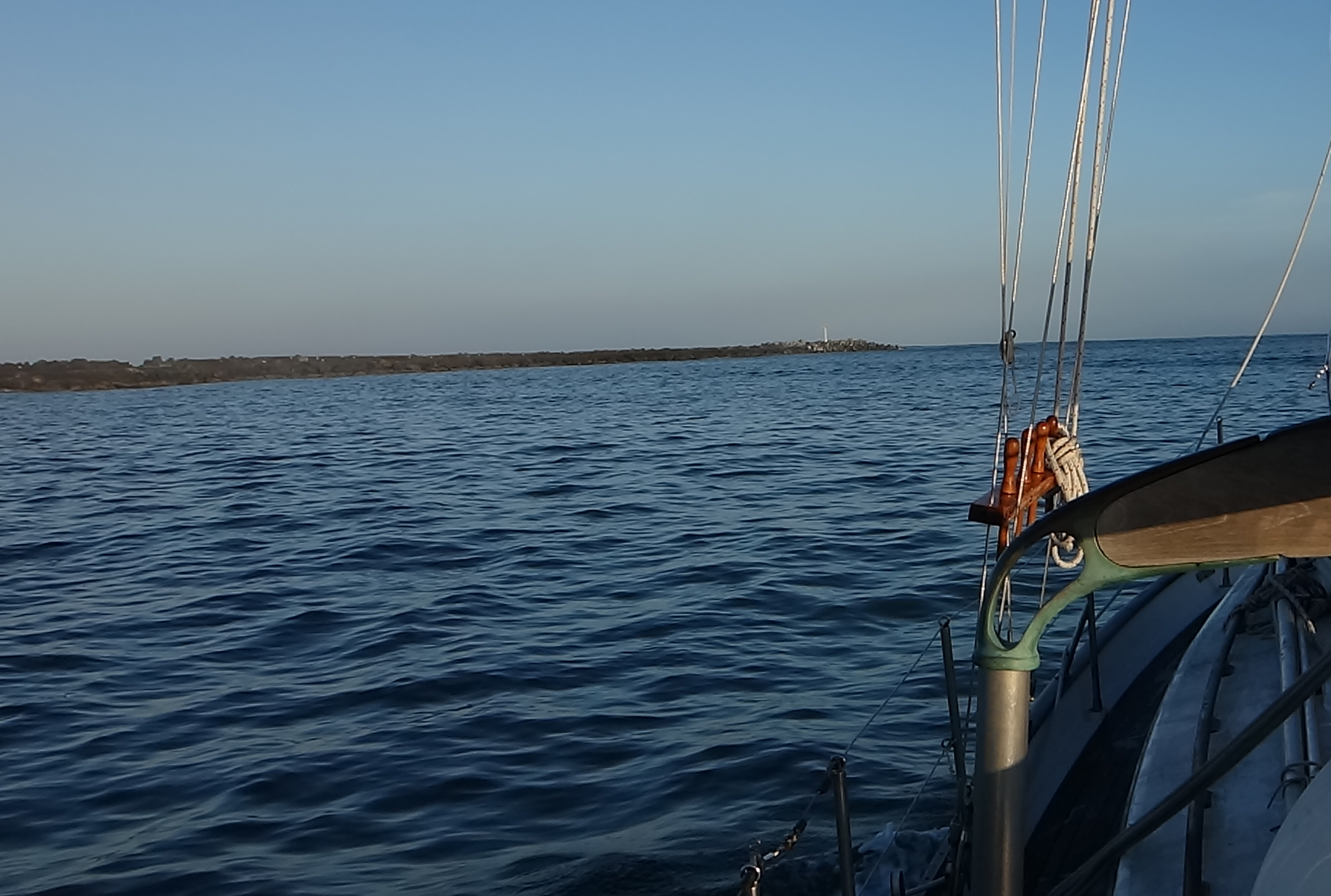
Rhino passing the Humboldt Bar Coast Guard Station at first light.
When you find yourself walking in the dark of night without a moon to guide you, the secret to staying upright is to look, not at the path you must walk, but off to the side, above or below. Even the darkest night has many different shades of black; the lightest one, the paler darkness ahead is the trail, but you can only perceive it if you look to the side and let your subconscious partner with the amazing sensitivity of your eyes.
For ten days in Eureka, we had been staring directly at all the weather information available to us, trying to make out the faint trail we must eventually follow across the Humboldt Bar and into open water. We searched the NOAA buoy sites, called up surfing websites to gauge the predicted swells, and pestered the Coast Guard office, grilling them on slack vs. flood theories. We watched storm waves approaching from Alaska and tried to guess when the waves would make it to our stretch of sea. Finally, two days before we were going to leave, we drove to the north jetty and watched the surfers being towed out to ride the breaking waves adjacent to the ship channel in the bar. Ok, confirmed: stay in the shipping lane.
We rose before first light, met up with our fellow cruisers on Rhino, and together motored through the flat water and into the rolling swells of the bar. As we reached the outer entrance, we were flung up and over several sets of four to six foot rolling swells, but it was fun, and we felt rewarded for all our hard forecasting work.
Entering the main channel on the Humboldt Bar.
Dozens of cetacean spouts geysered the green horizon, and one gray whale came so close to the boat that when a tall swell rose up to starboard, we could see the entire pale bulk of it resting just beneath the surface, longer than the boat. The wind picked up, and dolphins again came close to play in the waves kicking back from our passage. The breeze picked up another 10 knots, and wind waves formed on top of the growing swell. Hmmm. We did not expect this.
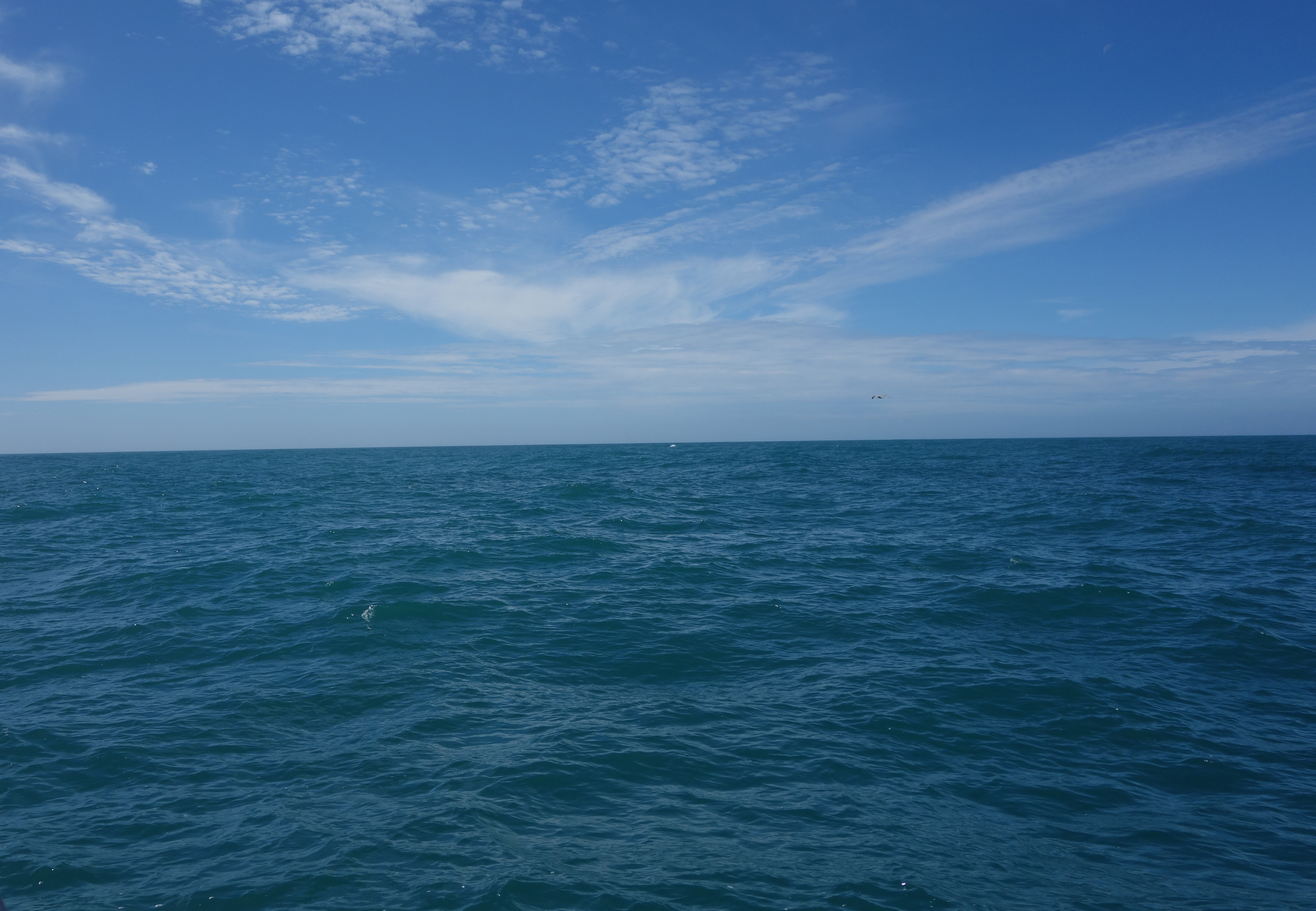
Looking astern to the north as we pass Cape Mendocino to the east, high winds aloft and frontal system approaching.
Perhaps, if we had focused our gaze a bit more to either side of Humboldt Bay and its haunting bar, we may have predicted the weather which found us Friday night as we cleared Cape Mendocino. As it was, we were so happy to have found the perfect time to make the crossing, we perhaps failed to understand that the rest of the forecast – gale winds bearing down from the north – could arrive a day sooner than predicted, bringing with them lower temperatures and a large following sea that rose up within an hour after passing the “Cape of Storms,” as the Mendocino headland is also known.
This unexpected wind continued to rise, from the placid 4 knots astern at the beginning of the day, to the muted roar of 25 knots by dark, and 30 by midnight. We considered the trysail and staysail, but to set them meant going broadside to the predominant swell. Since waves were frothing and careening up above the stern pulpit and down along the rails, we opted to keep motoring. A missed opportunity to try out the storm sails, yes. But it was very intimidating to go forward and raise both of them in the dark. Wade grimly accepted my veto, and the iron genny carried us safely through the darkest hours.
We exchanged 3-hour watches, hand-steering through the night, and by the time the quarter moon rose, the wind had lain down to a mere 17 knots, and the seas dropped back again to a six foot swell. The night took on a more human scale under the moon: the coast, seven miles off, had a shadowy glow, and Pelican Moon shone and heaved, a living creature of the sea.
When sunrise finally cast itself upon us, the water turned viscous, wave energy spent and transformed into animated roundish bumps that failed even to break the surface tension of the water. We hoisted the sails, grateful for the silence and the gentle motion, but never managed more than 1.9 knots in an hour before giving up and motoring the rest of the way to Bodega Bay.

Two-knot sailing with the Monitor in full command of the boat.
Now, again, we watch the weather, waiting for northern storm swells to pass, and gauging our best departure. We read not only the local forecasts, but the ones far to the west and north, and watch as they pass over the sea to arrive on our shores. With each coastal passage we gain more faith, both in our boat and in our abilities. Perhaps someday we’ll stay upright and skirt the storms by watching with the inner sight, the one which needs no light to find the way. Until that time, we remain ever grateful for NOAA buoys, surfers, Coasties, meteorologists and fisherman. Long may they ply the seas and chart its ways.
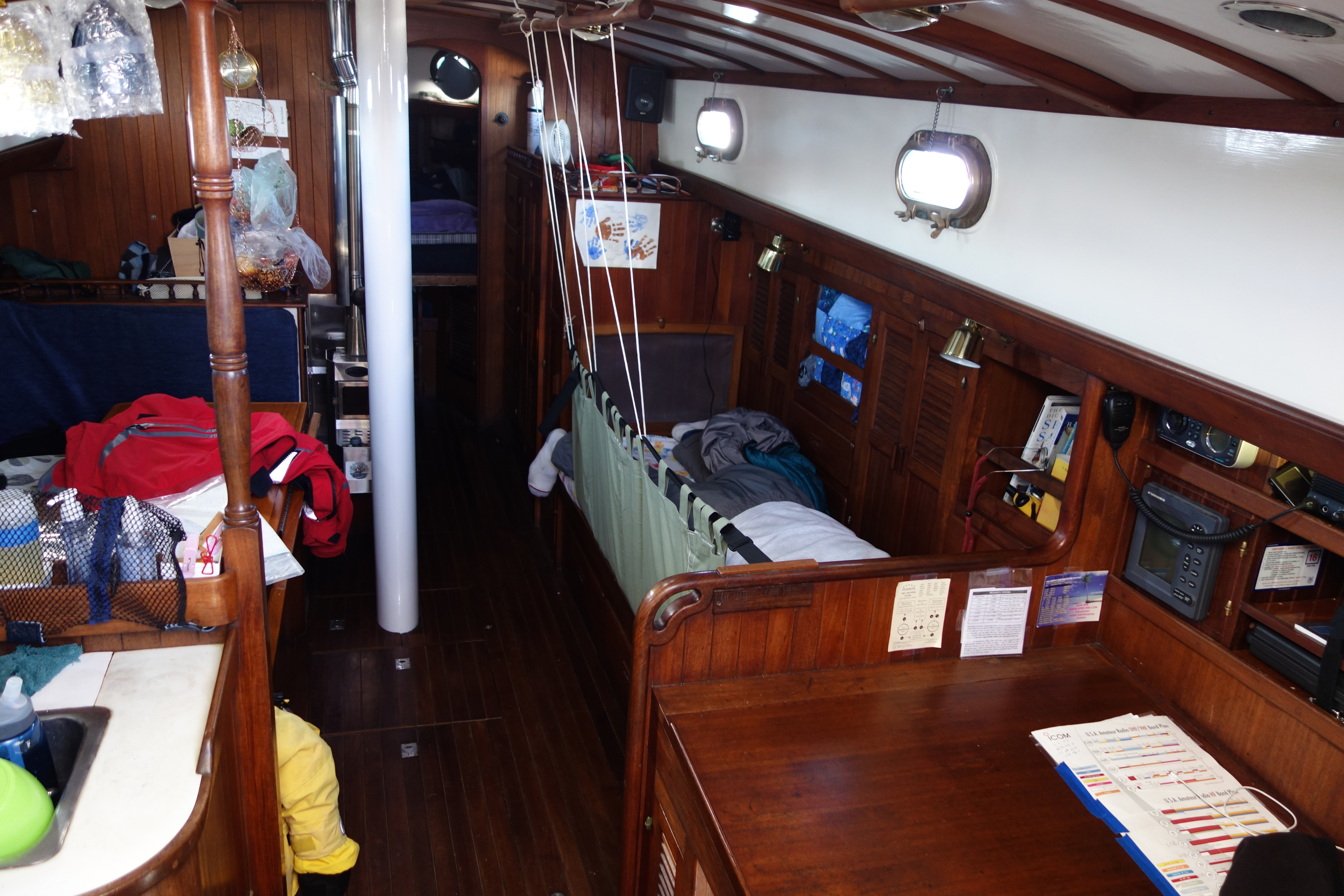
Finally getting some deep sleep after turning off the motor.
 sailing pelican moon
I can almost smell the sea. thanks.
fascinated by your excellent articulation and phrasing of the events you experience, Carla your writings are at a professional level and enjoyable to read.
chic