

We left San Carlos on a comfortable and fast beam reach. Ahmeek’s main and mizzen sails bladed through the humid air, foresail pointed south, white wings steady in the nearly flat sea. Pelican Moon paralleled her course a half mile off, and with her own three sails pulling easily, both boats made an easy six to six and a half knots. Looking forward to a four day passage to Mazatlan with a bright moon guiding the way, we were relaxed and happy to finally be on our cruise.
Ahmeek’s crew saw whales; we had a dolphin escort. The breeze stayed steady, and we leaned into a course taking us out around 25 miles offshore, hoping to avoid most fishing nets and boats.
We commenced motorsailing when our speed dropped below three knots. Early in the morning, we began to pick up small boats and buoys on the radar, and several times we were flashed with a bright light by solo fishermen in pangas* who wanted us to avoid them, and/or their nets, and so we weaved through the darkness. One mile off, we could see Ahmeek’s running lights: red, then green, then red again, confirming visually what they had told us on the radio: fishing nets all around. The lights of larger fishing vessels shone in the distance: shrimpers and trawlers and purse seiners, and we made multiple minor course adjustments to avoid them all. Under such pressure, how can there be anything alive left in the sea? After a couple of hours we got through the worst of it, and soon both boats were able to turn off the engines for a few hours when the wind came up. By mid morning, however, we were back to motoring.
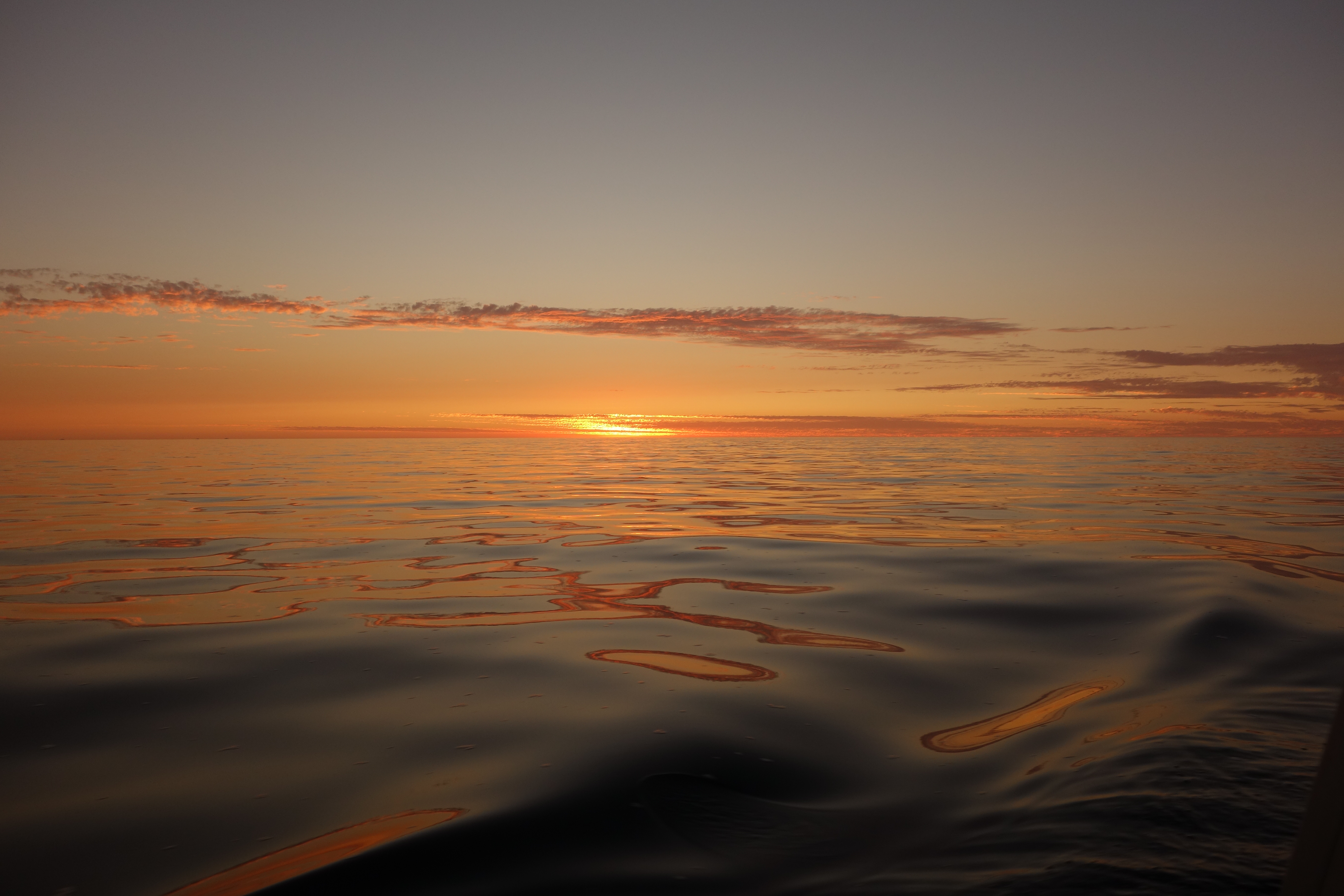
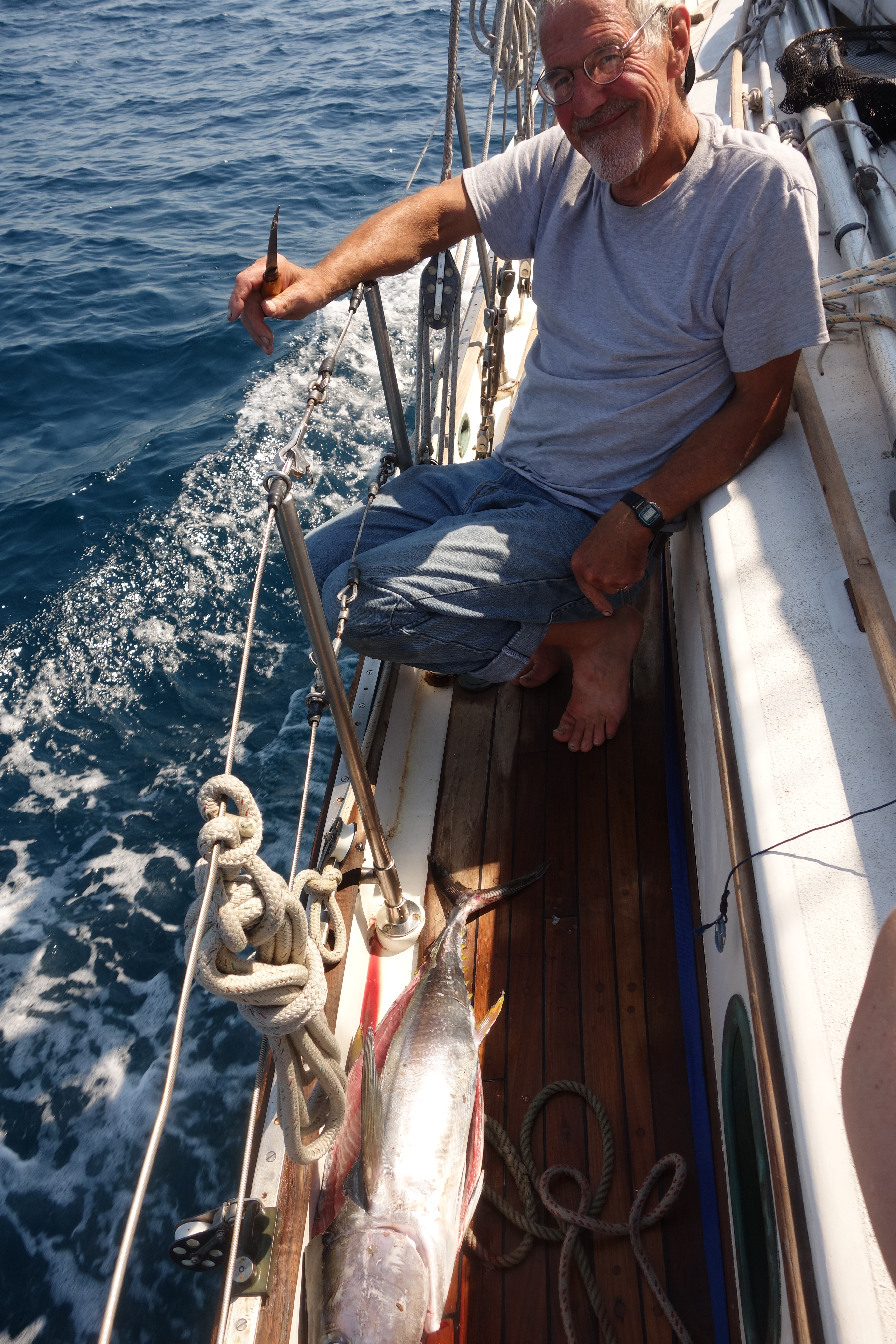
Pillowy seas smeared sky-reflected colors around the hull, and we endured the iron genoa for the next day and night. On the third day, we all agreed that a sojourn in seldom-visited Bahia Altata would give the motoring a rest and a chance for more wind after a few days. We altered course ten degrees to bring us to the bar, and while motoring along in 40 feet of water, Wade hooked and brought onboard a 25 pound yellowfin tuna. What a feast we would have later that night! And for the next three days! And to be shared with Ahmeek and their (4) cats! Sashimi, pan-seared steaks, grilled roasts, salads and sandwiches. Everything but the tuna casserole.
We arrived at the narrow bar entrance near slack high tide, as planned, and also near to sunset. The bar crossing and subsequent 10 mile trip north up the narrow lagoon to the town of Altata has reported navigable depths of only 10-15 feet; not very much water beneath the keel, and we had read that the channel is narrow, the sandbars change over time, and it lacks buoys. We had some waypoints to follow, passed on via the internet by boaters who had gone before, but they were all more than a year old. Not wanting to compound the risk of arriving at an unfamiliar port in the dark with the added adventure of a migrating sandbar entrance, we decided to call the Port Captain for a guide.
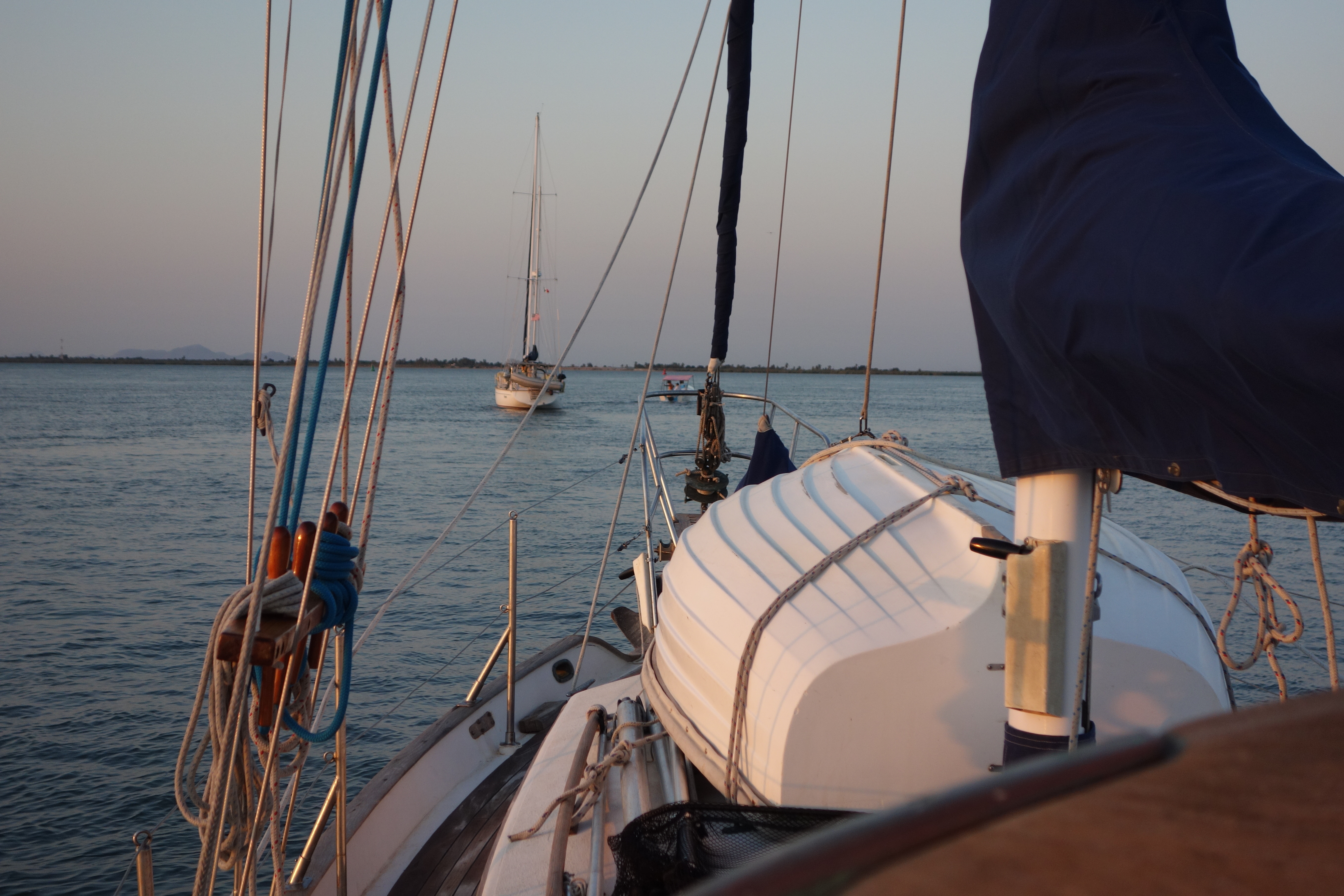
Following Ahmeek and the pilot launch across the bar entrance.
From the approach buoy just off the bar, we saw two more sets of buoys further ahead, and wondered if we really had need of the guide, but it was too late to change our minds. We followed dutifully behind our escort, across the bar, tight to the red buoys, and up through the long lagoon, wondering briefly if our decision was sound as the depth dropped to 13, then 11, then 8 feet of water below the keel. However, all was well, and as we approached the municipal dock fronting the town of Altata, we passed by dozens of mysterious, brightly-lit small craft, some anchored, some moving slowly downwind.
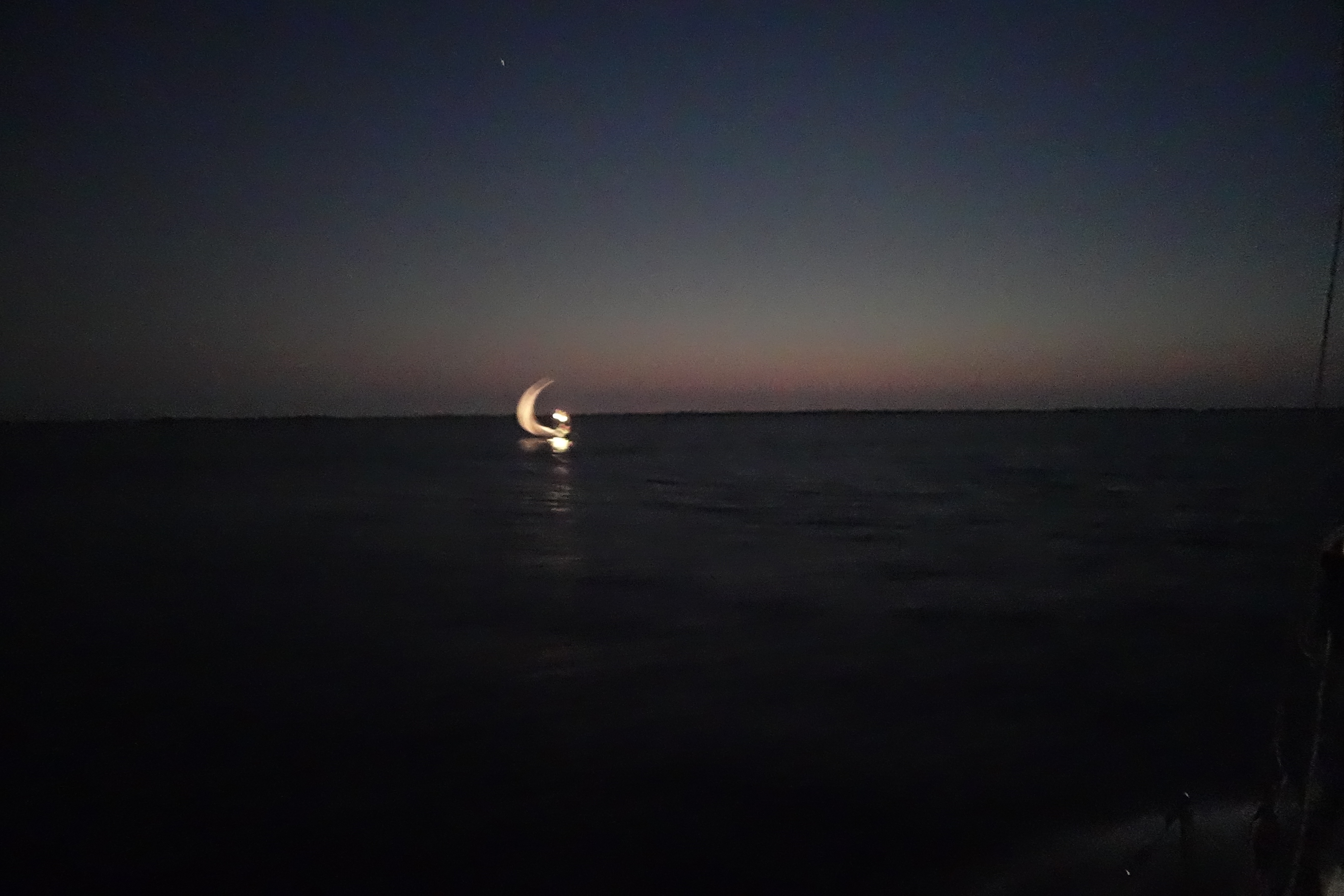
The sailing shrimp fleet of Altata works night and day, and their brightly-rigged boats were to delight us throughout our stay. As we approached the dark anchorage, our escort went alongside the public dock and we saw a man leap into their boat. The Port Captain himself had come to welcome us, and to make sure we came to see him the next morning in his office.
Our meeting was very interesting. The Port Captain first spent quite a long time making sure we understood how to calculate the tide offsets for Altata (yes, we did), and then clearing up why we had not asked the San Carlos Port Captain for the bearings across the bar and into the lagoon. When we explained that as far as we knew nobody can ever find the Port Captain in San Carlos, and that as a result nobody tries anymore, he had choice words, in Spanish and with some heat. Capitan Alejandro is an energetic man who loves his town and makes sure that the fishermen who lead us uninformed sailors across the bar are paid fairly. We were initially shocked by the price, but he explained that these men provide the guide service only as a favor to him, and not at his command. It made sense to us that they should be reimbursed for their gasoline (80 liters) and time (4 hours). Just last year, a sailboat that had no guide across the bar ran aground in heavy seas and came to ruin. In the end, we were happy to pay the price that we did. Feeling bemused and somewhat chastised, we wandered off in search of good food and more local wisdom.
We fell into conversation with the owner of one of the many small restaurants lining the waterfront, a man named Carlos but called “Charlie” from childhood because of his blue eyes. He went out of his way to help us understand the history of the area, the shrimping fleet, the hurricanes and the 16-foot waves ripping across the lagoon which only a few years ago destroyed so much of the town that the government stepped in and built the new seawall and malecon*, new buildings for the restaurants, and a mysterious palapa tower which is never used but always guarded. The city decided to allow public consumption of alcohol, because the city of Mazatlan had just banned it, and the result was a surge in visitation from the nearest large city whose residents were happy to shift their party location. For better or for worse, Altata’s future is now tied to beach revelers from far inland. Thefts have increased, but, as Capitan Alejandro told us: “Those people are from somewhere else. Our people here are good people.”
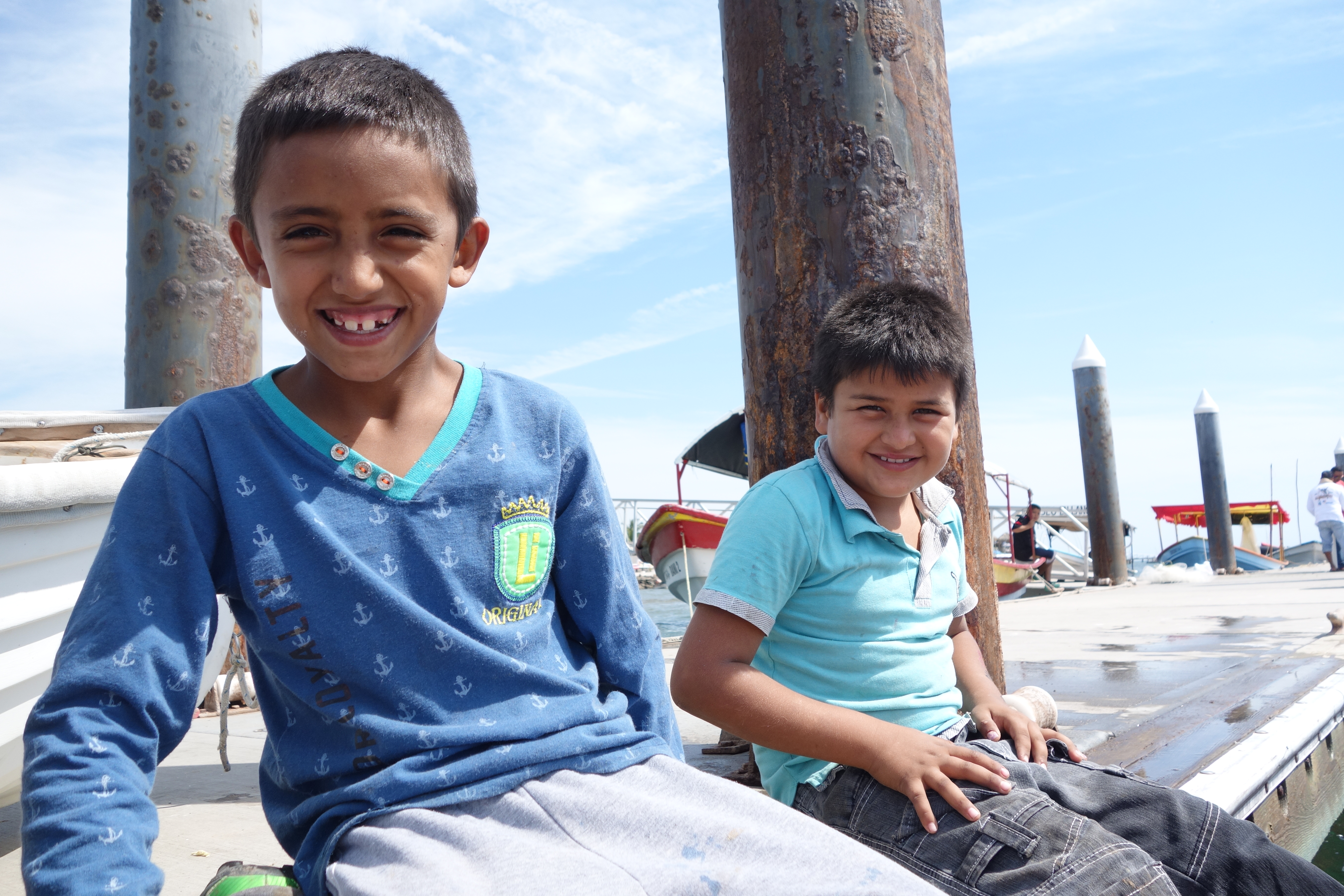
Two of Wade’s helpers
During the next several days, Wade hauled out the dingy on the dock to reinforce the gunnels. He was verbally aided by young boys and grown men each day he worked. Carla fluffed up the boat’s stores with baked cookies and her new hobby, making homemade non-dairy cashew cheese for Wade. She finally inflated the kayak for the first time this year, and enjoyed several outings: birding with Ahmeek’s crew in the mangroves and across to the sand spit separating Altata from the open sea, paddling 2 miles further up the lagoon to where it splits off to a small marina, back and forth to the dock to help Wade with the dingy. Capitan Alejandro stopped by in his patrol zodiac a few times to make sure we were enjoying the town.
Evening strolls on the malecon with Altata’s inhabitants revealed friendly people with a love of oysters and music. We were entertained by our Friday night walk, when hundreds of inland city dwellers roared into town for a ritual weekend promenade to the crashing sound of multiple dueling small banda groups (tuba, snare drums, trumpets, coronets, accordians), all playing at the same time and accompanied by their fans singing along with them. The music lasted throughout the night, paused at 0430 or so, then started up again with the roosters at 0530. All three nights of the weekend. We wondered if the original residents of Altata were content with the deal they had struck with tourism. We hope so, and hope that more cruisers will brave the bar and experience the beauty and friendship of this Monday through Thursday sleepy fishing village/Friday through Sunday party town.
Our boat jobs temporarily complete, with the full moon in her glory, after five days we finally had to leave Altata in our wake, if only to catch up on our sleep. One hundred and thirty miles ahead lay the golden city of Mazatlan, and the forecast called for fair seas and a brisk wind to get us there. As we made the final approach to the bar on our way out, a panga with three fishermen aboard sped close to us, then stopped a little ways off. Two men stood up, hoisting a huge reddish-golden fish as long as they were tall, and wide enough to obscure the men’s bodies. Their huge grins and the outspread arms of the third man indicated their pride, and perhaps wonder, that there are still such fish in the sea. May it always be so.


*malecon, the broad sidewalk along the waterfront, often enhanced with statues, tiles, plazas, palm trees and small palapas. Think “boardwalk,” but in concrete.
*panga, the ubiquitous small fishing boat of Mexico, often powered by huge outboards to enable planing
 sailing pelican moon