
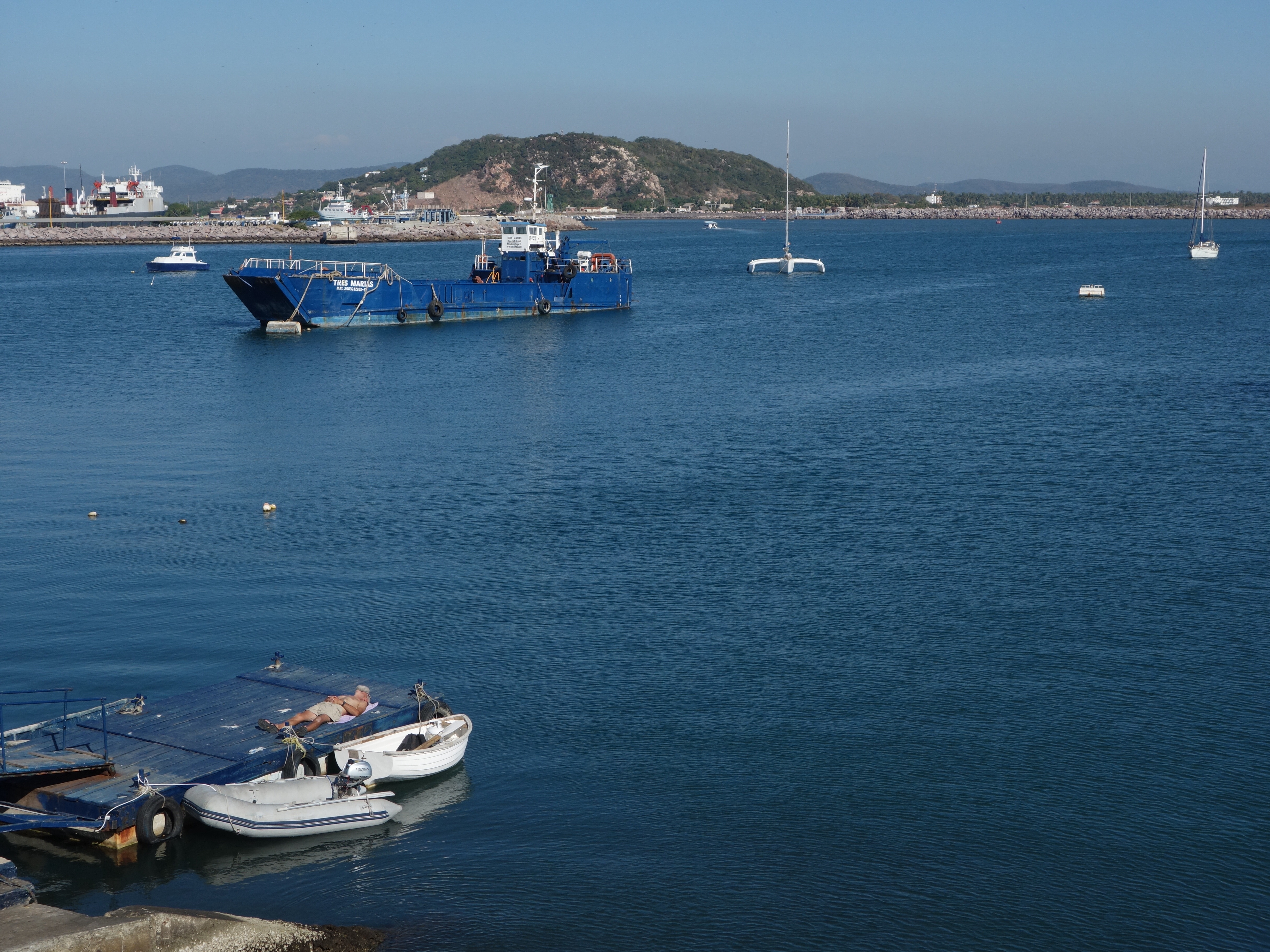
Christmas eve, all voyage preparations complete.
Something we are slowly learning from this sailing life is to expect that we will seldom encounter that which we expect to find. This disconcerting maxim is followed by the joyful corollary that natural events will continually surpass our unimaginative hopes. We fret and furrow our brow, trying to understand weather patterns or navigation problems and perhaps failing to really see our extraordinary surroundings. But a time always comes when we casually raise our eyes to the horizon or the heavens and are jolted from our mundane worries to a vision of paradise, celestial or cetacean or something other. This is sailing on the Sea of Cortes.
The first time we tried to leave Mazatlan for the Baja Peninsula, we got hammered by large, choppy swells just motoring the few miles from our anchorage to a marina to buy diesel. When exiting the narrow entrance channel we were swept uncomfortably close to the jetty by the powerful, breaking swell that had developed while we were at the fuel dock. This little trip was so unpleasant, we spent the next week and a half plotting weather forecasts, looking at what the winds were doing to the north of us in an attempt to find a couple of days for the 200 mile crossing when the swells would be manageable. We aren’t worried about wind, per se, but when the norther lies have been blowing vigorously in the northern Sea for several days in a row, it sets up these nasty high waves at 4-5 second intervals in the southern Sea, even if the winds have been calm locally. Ugh.
As we wrote earlier, on the night before Christmas, we realized that if we wanted to get across before the new year, we had to leave the next day, even though there would be no wind. After two weeks of worry, the trip now seemed as though it would be anti-climatic in every sense. We were going to motor straight across the Sea, without any swells to knock our course one way or the other. We were going to be bored.
We left Mazatlan on a glass calm sea. For hours, the engine rang in our ears as we took turns trying not to doze off at the helm. And then a pod of sleeping sperm whales drifted across our bow, so close that we had to swerve hard to avoid rudely awakening leviathan.
Now fully awake, we ate our evening meal as the sun drifted into a golden western sea. Wade went below for sleep, and I began the first night watch as the crescent moon came into its own, a great white smile in the sky. It is always a very fine thing to have a bit of moonlight for an overnight passage, especially for the first few hours to ease the transition, so I was not looking forward to the early moonset, due at about 2145.
At 2130, the sky went dark as a thick band of clouds obscured the moon. The waters blackened, became more solid, and lesser stars grew more visible. My eyes strained. A moment later, a vivid red stain appeared on the water at the western horizon. As the moon re-emerged, now a blood-red grin, the stain spread toward the boat until it intersected with the ripples pouring from our hull. The moon lowered toward the sea. I fully expected it to descend below a flat horizon. And then in the blink of an eye, everything was different.
The moon was setting behind the southernmost tip of the Baja Peninsula. I could discern the familiar outline of the Cape. I quickly checked the bearing on the chart to verify. From 125 miles away, I watched a crimson scythe settle behind the cliffs of Los Cabos. For an instant, it seemed a great ship was balanced on the rock, then broken in half. Slowly, inexorably, the rock overwhelmed the light, until the the red stain pouring across the sea to meet our boat was divided into two by the rocks at Land’s End, and then the light was no more.
Again, blackness. We motored onward, the boat gently swayed. All the stars of the milky way emerged into a glittering band of pure white light, mirrored in the water by the phosphorescent plankton tumbling alongside and behind us in our wake. Because the sea was so calm (so boring!), the tiny glowing organisms remained visible for a long time, and I could see them sparkling through the placid water several feet down, and for several hundred feet beyond the stern.
A little breathless, I will admit, I turned away from the overwhelming beauty of the moment and tried to understand everything else that was happening. Our bearing from Mazatlan to Bahia de Los Muertos fell almost exactly along the Tropic of Cancer. The planets were aligned from horizon to horizon along this 23rd degree of latitude, the place where north becomes south, where the true tropics begin. All through the night, the planets were passing directly overhead or beneath us. Following close behind the moon and dropping into the Sea were Neptune and Uranus. Jupiter shone brightly just above the Eastern horizon and then raced above us to the dawn. Obscured by the sun’s power, and unobserved on Pelican Moon, Venus, Saturn, Mercury and Mars had all earlier slipped into the sea behind the same Cape cliffs.
A week of worry, followed by a sense of let-down that we had to motor to our destination. Then five sleeping whales awakened us to the potential of our world, and the heavens opened before us. For on that day, resigned to a motor-bound Christmas spent far away from family and friends, we sadly put away the decorations in the morning, only to find them again that evening even more brightly illuminated, filling the sky, the water, our hearts, all around our small boat upon the boundless sea.


 sailing pelican moon
Your writing brings us much joy and is a gift to us. Thanks.