
After the big blow while we were in Bahia San Evaristo, several of us who were anchored in the bay held an impromptu conference on the beach and compared notes on the event. Part of that debriefing, naturally, was an exchange on where we were going next. After hearing that everyone in the circle was headed to Los Gatos, we immediately decided not to go there. Call us unfriendly, which we are not, but an isolated anchorage is always so much nicer than a crowded one, for many reasons.
The red rock anchorage of Los Gatos is about 25 miles north of San Evaristo. Just 1.5 miles further is a point of land called Punta San Telmo which juts into the sea and provides decent protection from both south and north winds, depending on which side of the point you anchor. We had read in the guides that one could walk from Punta San Telmo to see the same rock layers that make Los Gatos famous, and so that is where we pointed the bow.
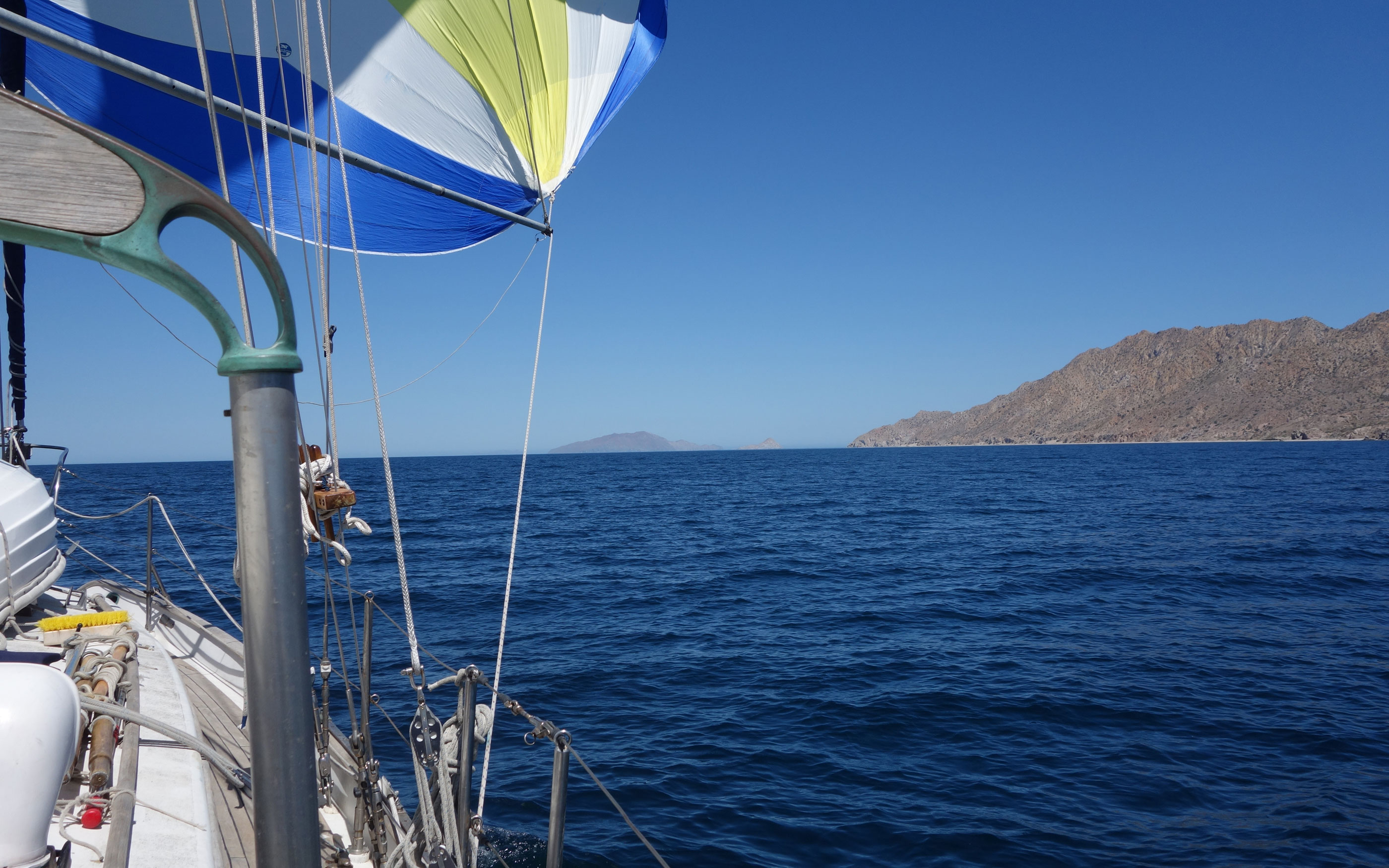
After mostly having to beat our way northward, imagine our pleasure when the wind actually filled in from the south as predicted, and we were able to set the spinnaker for a mostly downhill run. A cloudless sky made a crisp outline of Isla San Jose as we soared past on building 7-10 knot winds. We passed a group of lumpy whales that were unfamiliar to us; one of them seemed to be lifting or pushing another. We wondered about that for a while, and the wind built to 12 knots. We disconnected the whisker pole, took down the spinnaker and unfurled the genoa, thinking the wind might get too strong for our light-air sail.
Such is the way of sailing that soon after we doused the spinnaker, the wind died back down, so we furled the genoa and again raised the spinnaker, hooked up the whisker pole, and settled back in to our breezy run. Another group of lumpy whales appeared directly in front of us. They were moving so slowly we had to alter course sharply to port in order to avoid a collision. This time, Carla was ready with the whale book, and we were able to confirm that these were sperm whales, a new species for us! After reading that only a third of their body length is above the water, we were glad to have altered our course when we did!
The wind built and then dropped again, with the resulting commotion on deck for yet another sail change. By three pm we were tired of leaping to the capricious wind, so when it again crept up to 12 knots, we let the spinnaker run, and crossed our fingers. So smooth was the ride that when, at 19 knots, Pelican Moon was making 7.3, we were shocked to see the numbers on the instrument panel. By now it was too windy to take down the spinnaker without beating it and ourselves to death, so we held our breath and kept sailing. The sea was a hard, flat surface and our keel knifed through it, driving us ahead with barely a splash. After an hour of this unheard-of speed (for us), the wind moderated, then fell off again. When it started to rise one last time, we were only half an hour from the anchorage, so we took down our moderate-air sail, lest we were pushed north all the way to the border.
Only one other boat was in the anchorage, so we were happy with our decision, especially since we had glimpsed several masts poking out of the Los Gatos anchorage as we left it to port. The night was rolly, as Punta San Telmo protects from wind but not so much from swell, but we snuggled up in the v-berth and looked forward to a day of solo exploration on the lonely beaches and spectacular bluffs surrounding the point.
 sailing pelican moon