

Approaching Isla San Francisco on a close reach.
Two beautiful bays with excellent protection from wind and swells oppose each other across the Canal de San Jose. To the east is the respite of Isla San Francisco, bitten from the flanks of an old volcanos’ spew. Bahia San Evaristo on the Baja side shelters a small fishing town and there, we rode out the strongest winds we have yet encountered. Afterward we enjoyed the camaraderie with nearby sailors that often develops whenever humans spend their days outdoors in the wind and the weather.
But first, for three days on Isla San Francisco we enjoyed some overland hikes and encountered quite a few spectacular creatures (several of whom are immortalized on the poetry page previous to this one). We crossed the narrow isthmus dividing the crescent bay from the rest of the island’s bulk, then scrambled the cliff-backed shore at low tide until we ran out of land. Up and over a hill, down an arroyo, across a sand flat and we were standing on the northern beach. Looking over the dangerous, reef-strewn passage between this island and Isla San Jose to the north, we decided to wait for a windless day to make the crossing, if we ventured that way at all.
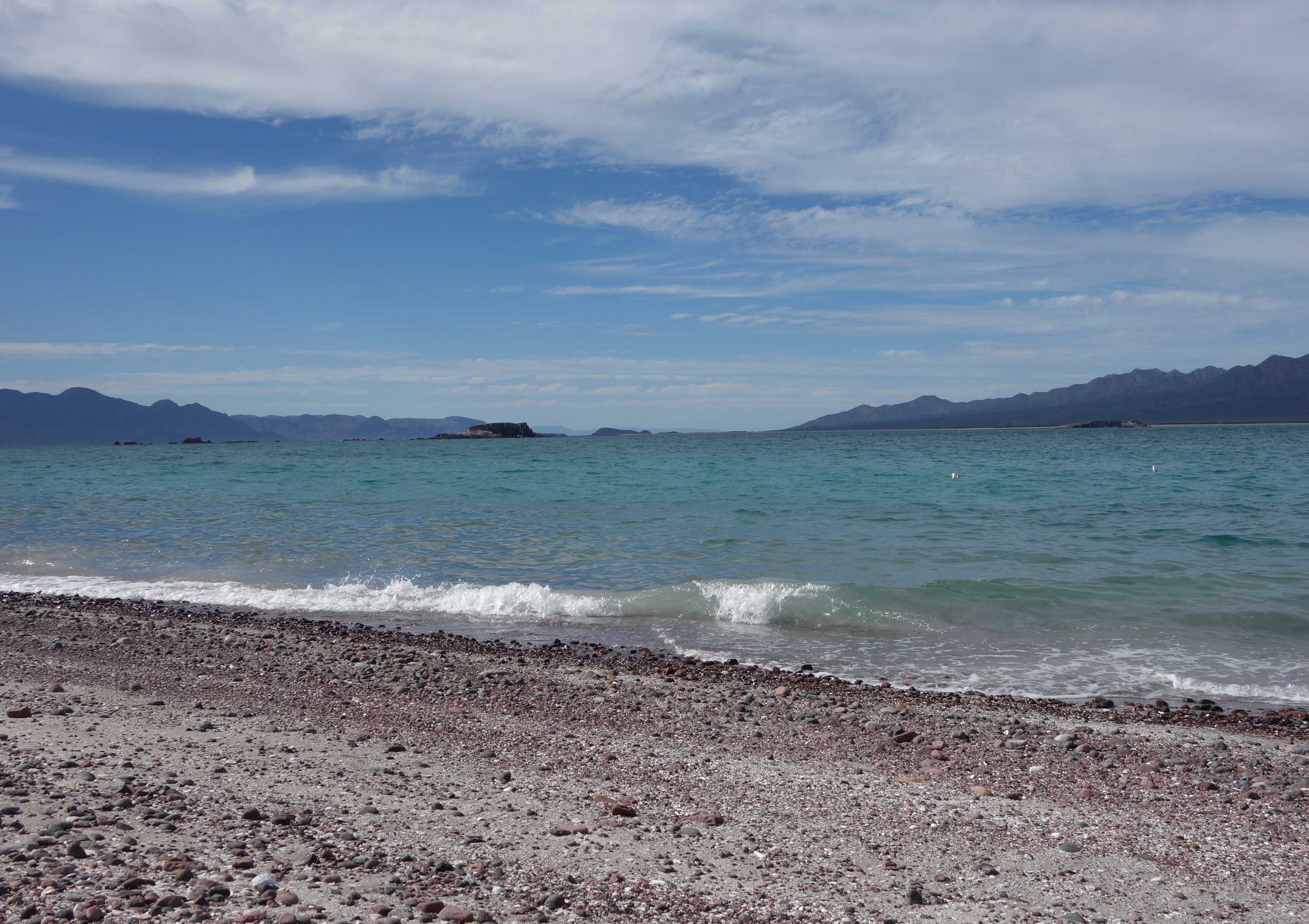
The entire walk was a visual treat. The rocks on the island are laid up in bands of pink and red and gray and buff and red. Wade called one section “Christmas Beach,” so vivid were the yuletide colors. Sally lightfoot crabs herded themselves ahead of us, and Wade captured a small one to use for bait later in the evening. We laughed at the funny American Oystercatchers squeaking around the barnacles, and then identified a familiar, aerial cry: searching the cliffs, we saw an osprey couple had built a home on a pinnacle of rock overlooking the beach. One adult circled us as we passed below the nest, and another bird nestled low and never flew out that we could see – another adult on an egg, perhaps, or maybe this years’ fledgling?

Osprey flying, with another in the nest. We’re standing on the water’s edge.
Yellow-footed gulls in pairs, a new species to us for they breed in the Sea of Cortez and only rarely fly north to visit southern California, were territorial along this stretch of rock. They squawked in order as we passed each duo, and soon we were out of their realm and crossing another, up loosely-packed volcanic debris barely cooled. So scarcely compacted was the surface that walking uphill was one part slogging through air, one part sliding dustily backwards. Our progress uphill in the growing heat was hard won. The arroyo on the downhill side was easier to walk yet extracted its own bloody toll from all the pointy green things, and we were happy finally to slog across the dried, muddied sand flat which lay before the beach, our boot prints joining those of great blue herons which had hunted in the brackish pool during the last rain. More unblinking gulls peered at us as we borrowed their stretch of sand, gathered a few shells, and dozed awhile before racing off to beat the rising tide back to the bay.

On the following day the ridgeline called our names, so we followed a well-worn trail to the top of the curving rib which forms the southern aspect of the bay. Once again, turkey vultures rode thermals past us, doubling back to make sure we had not yet expired. From our lookout we watched someone fishing in a dingy as they caught, and then reeled in and somehow released, a pelican.
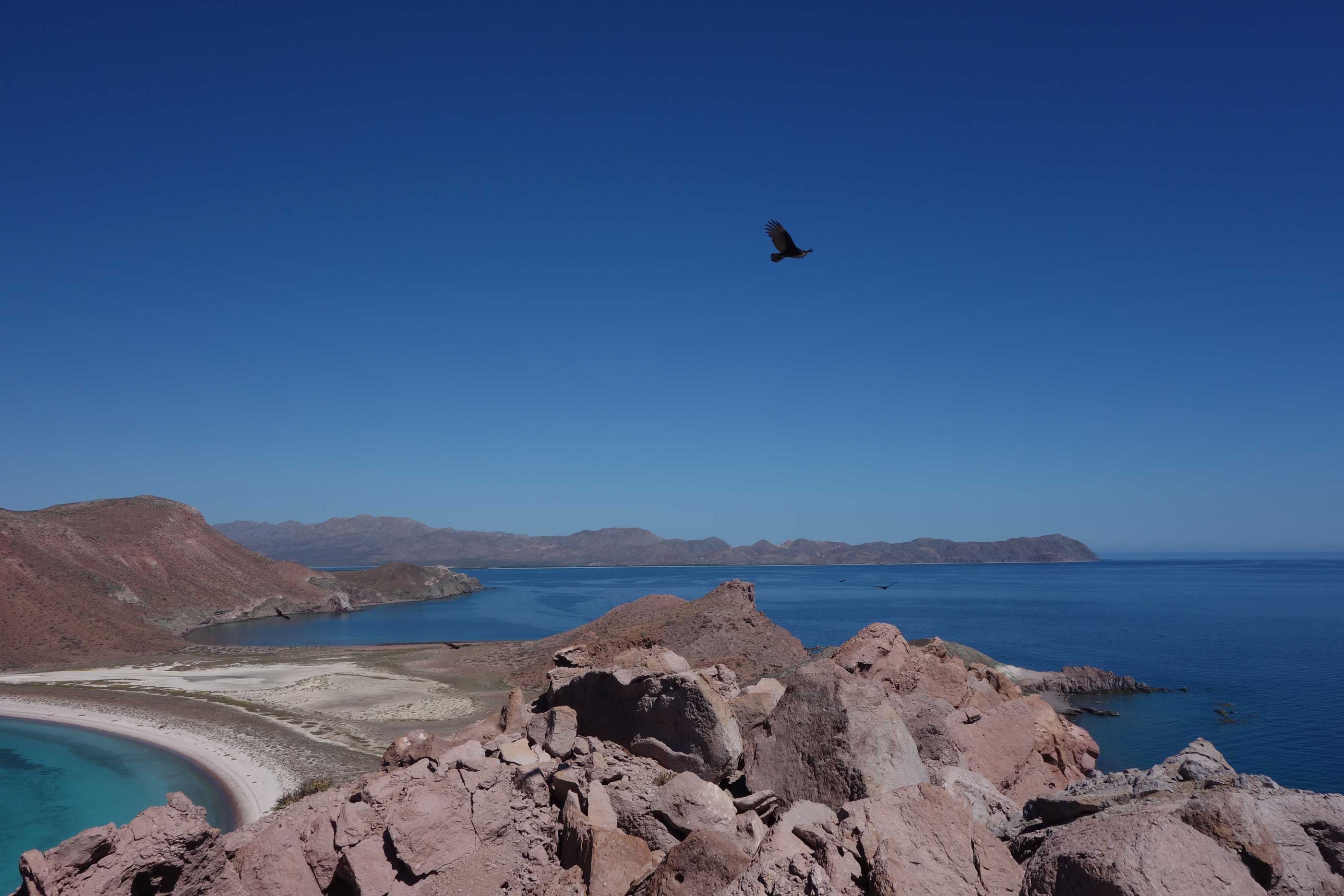
More slothful time on the beach, a row to the boat, a swim and a kayak trip around the bay made this a good day to say farewell. The next morning we weighed anchor first thing and sailed across the Channel to hunker down in Bahia San Evaristo, for we had heard on the radio that the wind was “going to blow like stink.”

Approaching San Evaristo
And blow it did. We rowed ashore for a few provisions from the tiny store, then Carla kayaked around the bay in 15 knot winds, and it was back to Pelican Moon. The wind rose to 20 knots overnight, and starting the next morning, we kept 24 hour anchor watches for 48 hours as Pelican Moon danced back and forth at the end of her snubber, buffeted by consistent winds of thirty knots and gusts to 43 or more. The gps let us confirm that we were not slipping over time, and our landmarks on the hillsides made it easy to keep track of the boat’s position. The other eight boats also did well, though the catamaran next to us had to raise anchor once, motor forward and set it again, victim to a twisted shackle joining chain to anchor which only allowed their Bruce claw to dig into the sand on one side.

Blowing like stink: 35-40 knot winds in the anchorage.
The morning after the blow we rowed ashore to stretch our legs on a wonderful hike, going as far up into the foothills of the looming Sierra Gigantea Mountains as our water bottles and time allowed. We followed our noses and the occasional burro track, and eventually reached the upper end of a smooth-walled arroyo. Descending a series of polished basins, we imagined ourselves to be water particles bounding down the boulders until we reached the sand. A few wild burros required a slow introduction, then we trudged along the wide, sandy wash, eventually emerging on a gravel road for an easy walk back to the dingy.
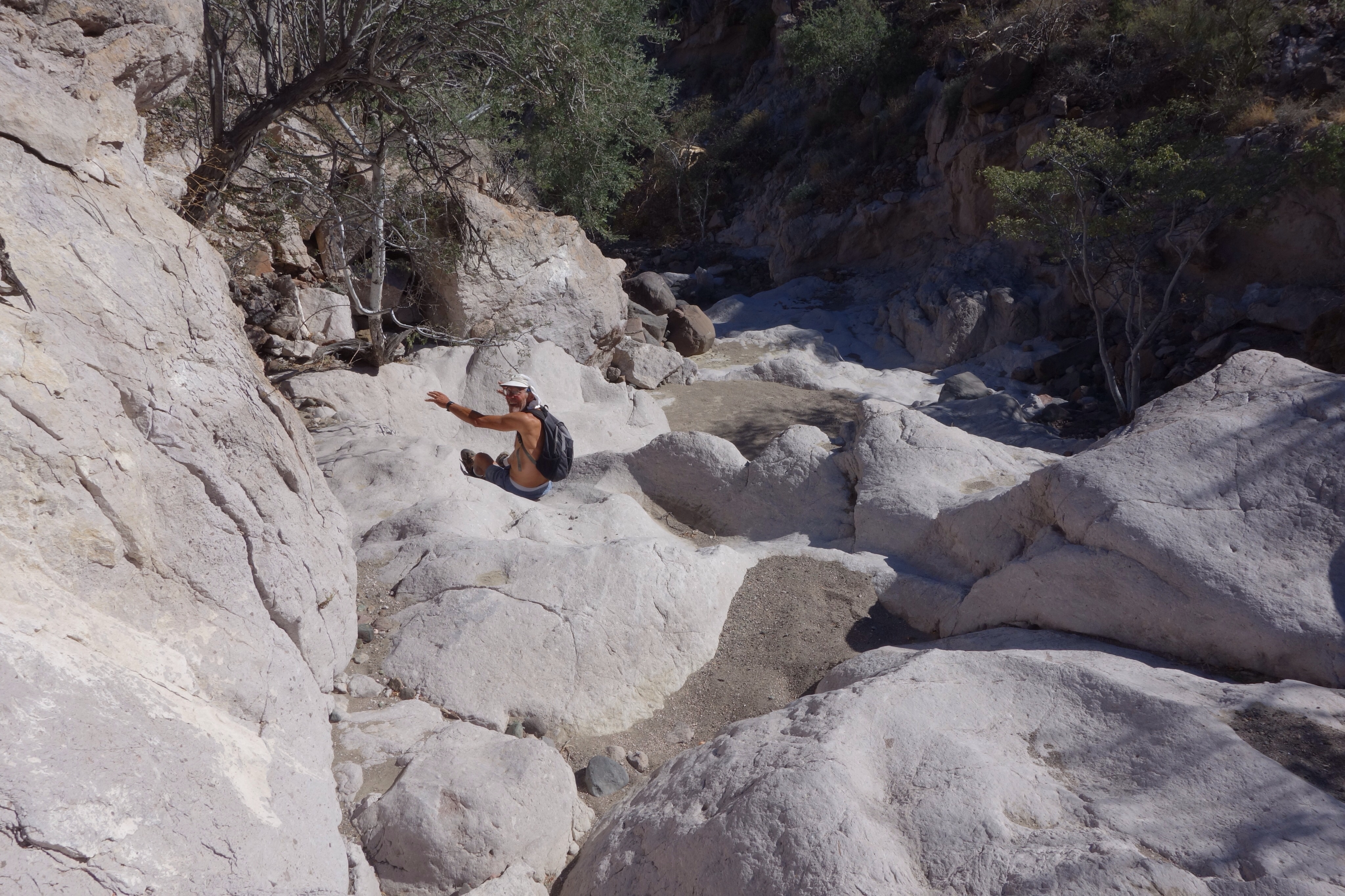
Wade riding the imaginary cascades through turquoise pools of summer rain.
On the beach, we rendezvoused with sailors from three other boats, comparing notes from the windstorm, talking of travel plans, admiring each other’s’ boats, and generally sharing in the relief of weathering “an event.” Just twenty-five miles north of us, in the “hurricane-proof” anchorage of Puerto Escondido, two boats had come adrift in 50-knot winds and suffered damage, and another 30 miles to the north the winds were recorded at 72 knots. Suddenly, our two days of tugging at anchor were reduced to a good practice run. It was time to crack a cerveza and toast our good fortune, and so we did.
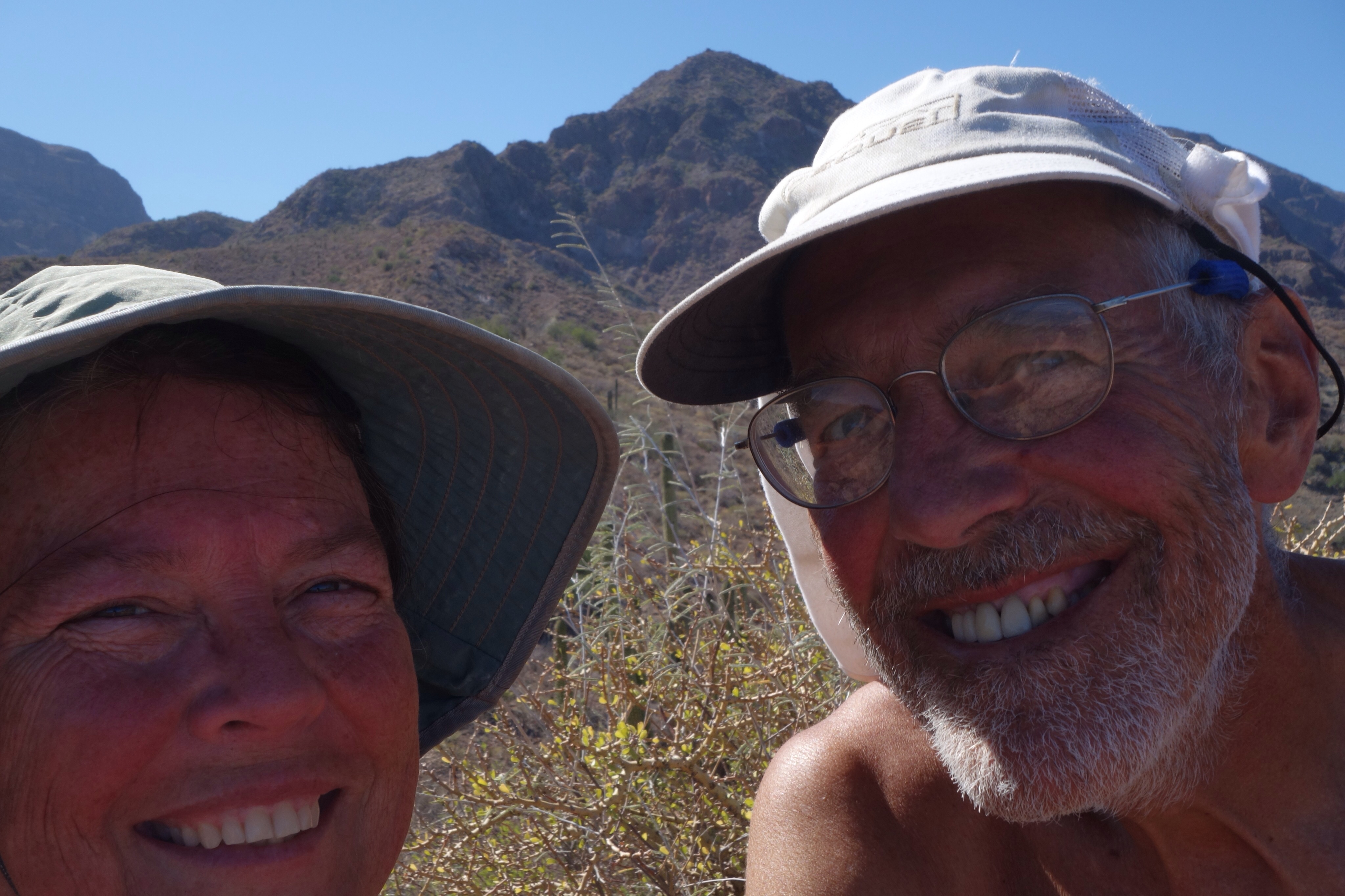


 sailing pelican moon