
Most of the photographs and captions follow at the end of the essay.
After 10 days hiking, kayaking, swimming and fishing in the Archipielago de la Isla Espiritu Santo, we’re motoring through a flat calm sea on our way back to La Paz. We’re down to our last two cold ones, and a quick re-supply and spare-parts run will get us ready for the next stage of the journey as we venture further north into the Gulf. Similar to finding yourself in the car after an extended backpacking trip, the engine drone is an intrusion and the speed of 6 knots feels abnormally fast. Slowly and surely, we are transitioning into desert creatures, the kind that prefers their anchorages empty and quiet.
Since we are unable to shed our fragile skin or metamorphose our watery bodies into something more camel-like, becoming a creature of this desert takes some work, especially for us damp-footed Pacific Northwesterners. Each time we ready the dingy or kayak for a trip ashore, the trailing foot on deck lingers, the inner survivalist surveys the salt water and the 80 – 90 degree heat shimmering over the volcanic red earth, and this sane person says: “Are you nuts?!? What’s in this for me?” Not in a greedy sort of way, but in an animal, how-the-heck-am-I-going-to-make-it-through-the-next-couple-of-hours sort of way.
The simple fact is that until our bodies are able not only to photosynthesize, but also to produce our own water, there is no living in this place without a lot of advance planning. We’ve both gone hiking in deserts before, counting the miles carefully between fresh water sources and then shaking like dogs after a plunge into cold desert rivers or hidden rock pools. We’ve sailed and kayaked the ocean’s bays and high seas, ticking off the miles on our charts until it’s time to go ashore for supplies. We’ve carried everything we need on our backs and wandered for miles and days into high mountains, knowing that even if something goes terribly wrong, we could always find water, and perhaps even food.
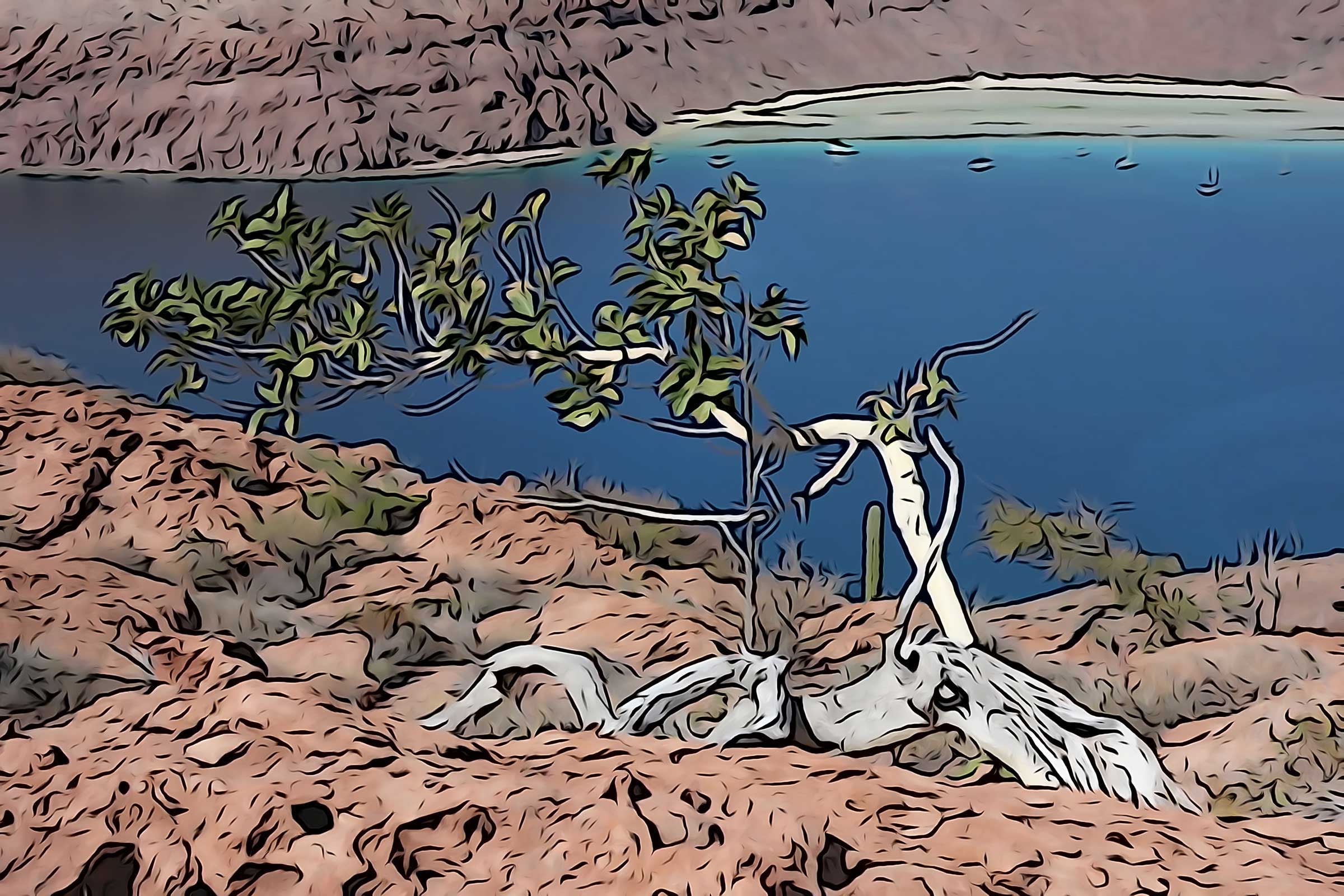
But here, where desert islands bereft of fresh water are surrounded by the undrinkable sea, which is in turn bound by desert lands even more barren, there is no casual encounter with wilderness. On our adventures, every water bottle we have is full; the large first aid pack comes along, as well as extra clothing and snacks in case our casual 5 mile roundtrip hike across the island turns epic. A single night and extra day out here with a minor injury could be disastrous. We have no map, so we even haul the satellite messenger with us, since no one, including ourselves, really knows where we are, or when we expect to be back. With only a couple of exceptions, we have been making our own trails, and those have been careful, meticulous scrambles up boulder-chocked arroyos, over rim rock cliffs of ragged, rhyolitic ash flows, across plateaus blackened by sun and occasionally shaded by squat, stunted, mostly leafless trees and the ever present cacti. And what are we finding out here?
We’re finding life. Everywhere. From the moment we drag the dinghy through a football field’s length of sandy mudflat pockmarked by thousands of tube worm piles and bivalve holes, to the thousandth time we have to alter our walking course to avoid another thicket of galloping cactus or spiny elephant trees, we find that the world keeps on living, even when the going is pretty tough.
Stopping to marvel at a swarm of frigate birds overhead as we approach the margins of a saltwater lagoon, we suddenly notice that each one has a bill full of sticks – the colony is preparing for nesting season! A pause to cool off in the shade of a blown-out volcanic cave seems always to call down a sweep of hopeful vultures from above. At the corners of our vision, desert doves and flycatchers flit covertly from one dense grove of spiny trees to the next. Where the rocks are ground down to sand, tracks abound. We see animal scat everywhere: judging by the different shapes we find, many kinds of squirrels and mice must live here. We finally spot a striped and golden ground squirrel dancing and leaping away from us, a wide flat tail curled over its back, up and over its head – perpetual shade, perhaps?
In the back of our minds, we are on the lookout for a special resident: a particular black jackrabbit which, in the whole wide world, lives only on the Holy Spirit Island. Soon after leaving the beach we find rabbit pellets, then tracks, and then Wade finds bones and a scrap of luxurious black and brown rabbit fur. Not only are there rabbits living here, but a predator must be as well! The frantic shaking of twigs and leaves soon reveals a furry creature bolting away from us. It’s black! A few minutes later we hear, then see another dark form exploding from a nearby thicket of dense cactus and racing for the next bush. Finally, by a revealing zig then a zag, we see the whole animal, all long legs and light colored ears and dark black-brown body. We wonder what animal it fears the most. Human, or . . .?
So rare is it to see a large predator, especially during the day in desert country, that we do not even consider the possibility. But on the way back across the island after lolling on the beach, gathering shells and giving Wade a haircut, we see a golden animal emerge from the bushes and saunter across the salt flat in plain view. A large mammal. A cat! Is it feral, or is it native? Seems way too big for a domestic feline. This stout creature is smaller than a puma, so perhaps a jaguarundi. Wait, it may have spots, but from so far away it’s hard to know. I grab the camera and snap off three faraway photos, and later that night, on the computer after enlargement and enhancement, we see that it could be an ocelot. An ocelot. That is too cool for words.
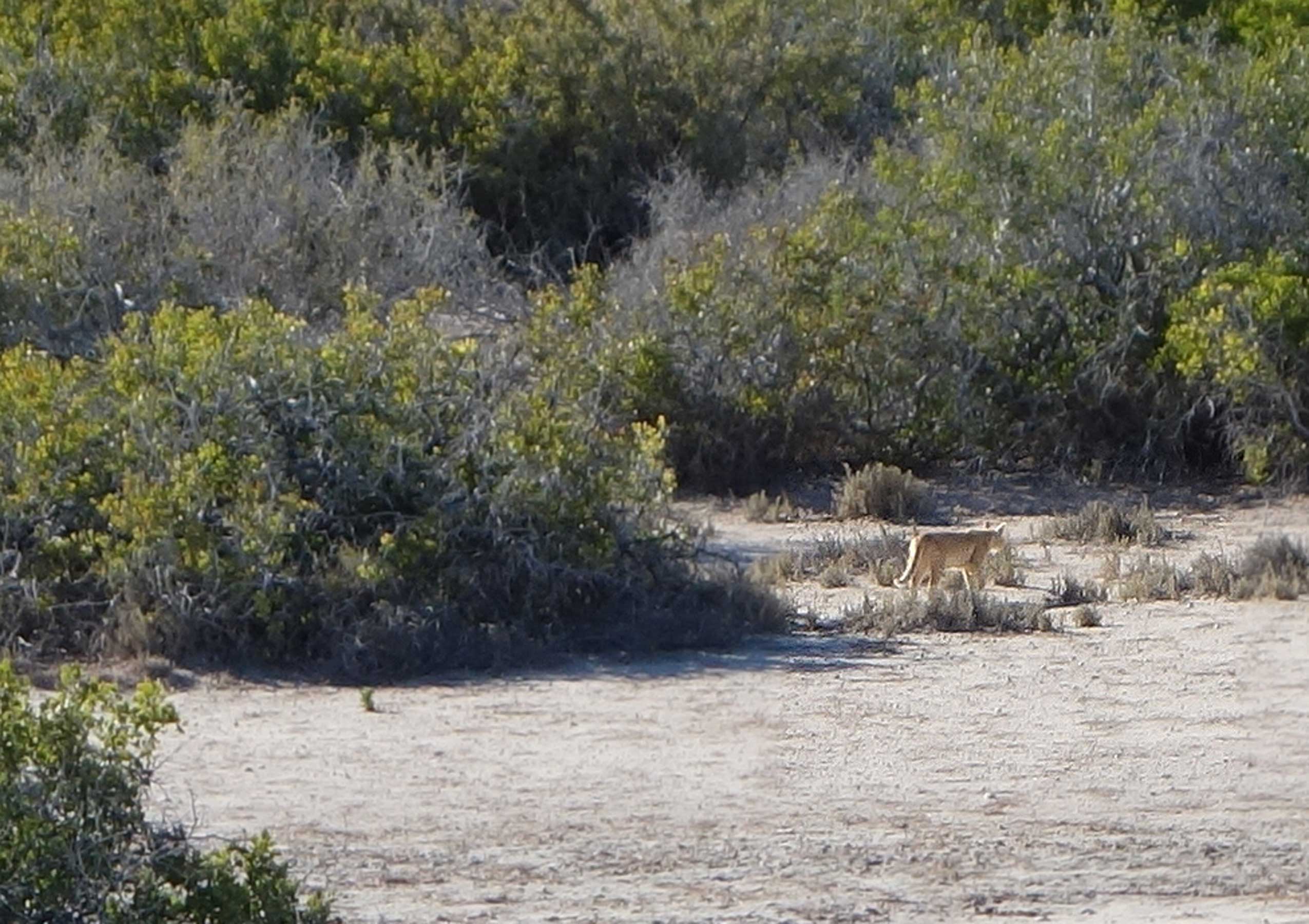
Ocelot? Jaguarundi? Young puma? Huge feral kitty? Anybody out there an expert?
The space between the two main islands in this archipelago is actually the worn down crater of a long-extinct volcano, and our hikes bear this out. Caves, thankfully, can be found on almost every steep hillside, their ragged sharp edges bearing testament to the violent gas-filled environment in which they first formed as cavities in the ash flow, later eroding to form the shady shelters we lounge in so gratefully. Exploded black basalt bombs full of shards litter the ground, and hollowed-out shattered shapes like huge pipes and pots and blocks are strewn across the plateaus and hillsides, remnants from the angry hand of a raging giant. Walking about in this country is no time to daydream; our shins and calves bear the scars of every wayward thought we might have had during these hikes.
These volcanic forms and colors take on a different look entirely where they meet the refining stroke of oceana’s hand. Ruby crabs with spotted legs and claws seek their sustenance while roaming across billows of pink volcanic foam. Ragged cliff edges strike a pose with grimaces and grins, and while kayaking the shores, we don’t know whether to look up at the figures and rainbows above us, or down to the sparkling darting shapes below. To concentrate on either world is to lose some precious glimpse of the other, and our paddling cadence slows to almost nothing as we drift between these two galaxies, the rose and the aquamarine, the one born of fire then cooled and now again sun-hot, the other one a heat-quenching fishbowl. Slipping tentatively into these clear green waters is a mesmerizing visit to a world where we cannot linger for long, but where the forms of life are even more abundant, diverse, strange and yes, delicious.
For, like every other animal in the ocean, we do eat our dive buddies on this trip, gratefully taking a small share to our plates from this Sea. We’ve eaten spotted sand bass, a pacific porgy and a triggerfish from around the islands, and while Carla feels the former vegetarian’s twinge, Wade is doing what he loves best, and we both enjoy reading about the life and death histories of whatever fish we find on the end of our hook. One thing we have learned from our brief adventures into these desert islands is this: even in the salt and the extreme heat, life endures, life proliferates. There is food and there is water, even if you have to break open last year’s sour pitaya fruit to find it (we did, and it’s pretty darn tasty and juicy). Now, about these last two beers: how far is it to La Paz?
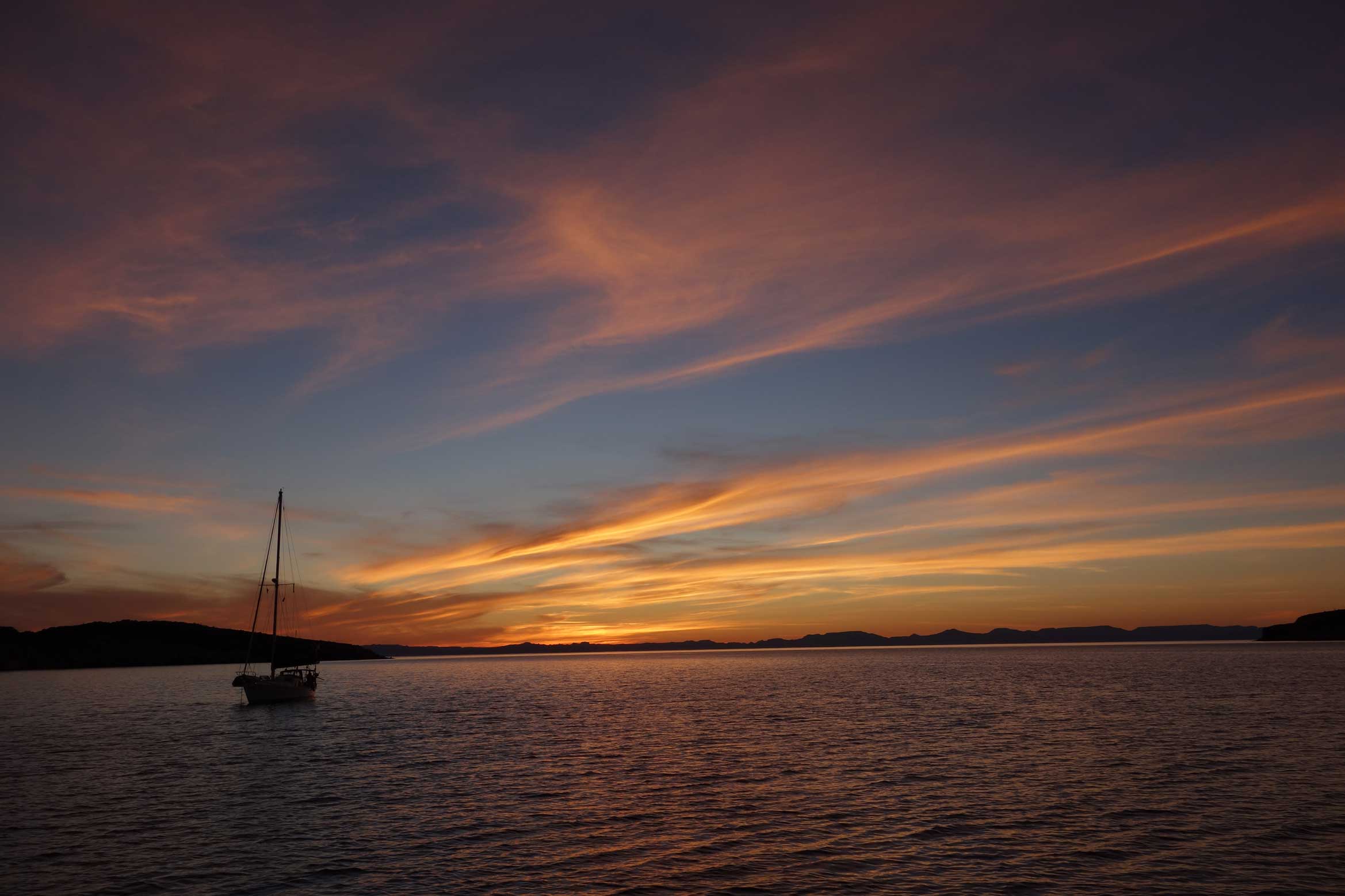
Sunset in Ensenada Grande, looking west to the Sierra Gigantea range on the Baja Peninsula.


.
 sailing pelican moon
Terrific tale Carla. Will certainly look forward to the book version
when it’s published. Please, I know good writing when I read it.
Love, Dad