
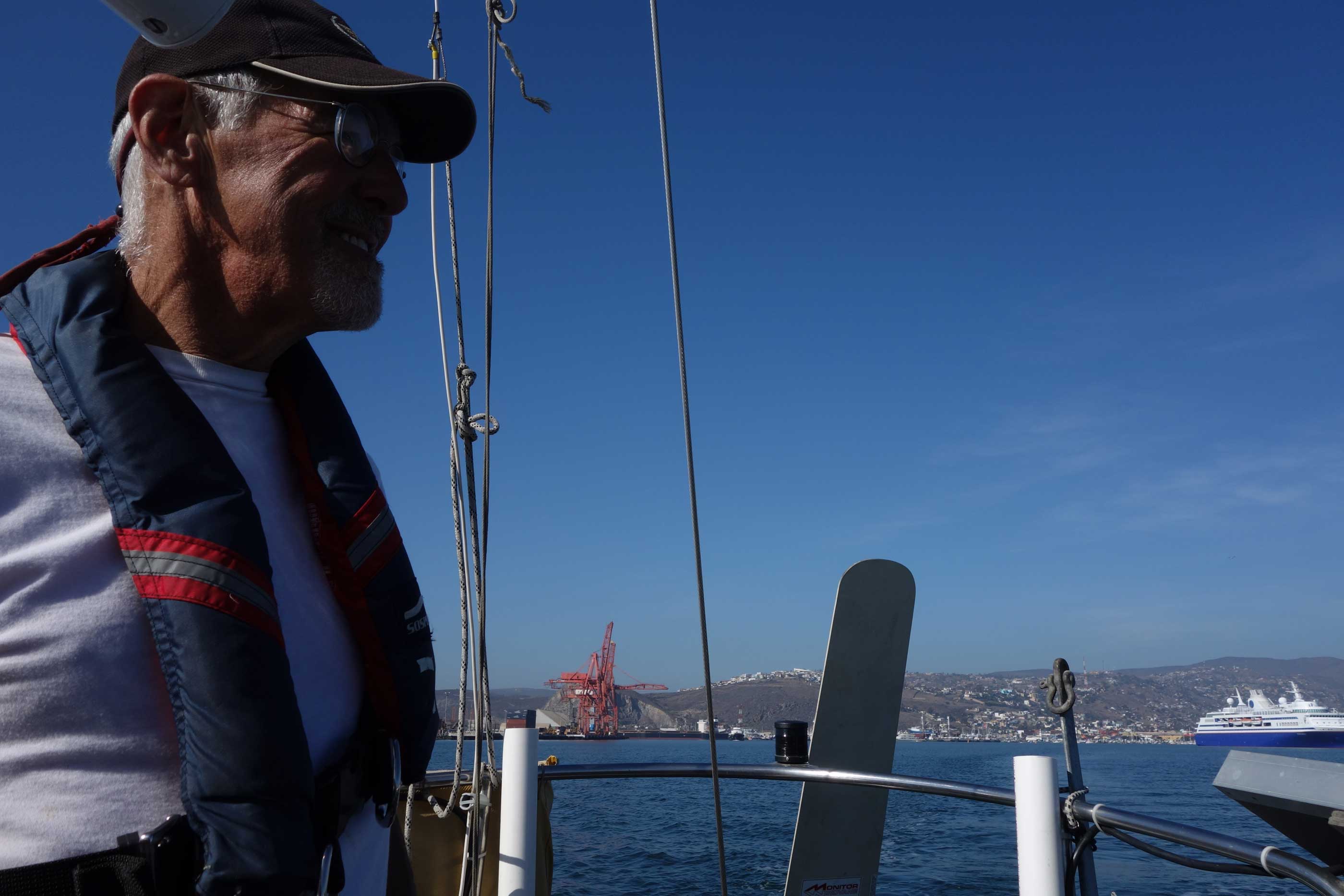
Leaving Ensenada in our wake.
I do not exaggerate when I say that Wade has been looking forward to two things about this trip south: sailing, and fishing. Now, these two activities do not always go hand-in-hand. Seems we never get enough sailing, so when we do have the wind we want to GO FAST!
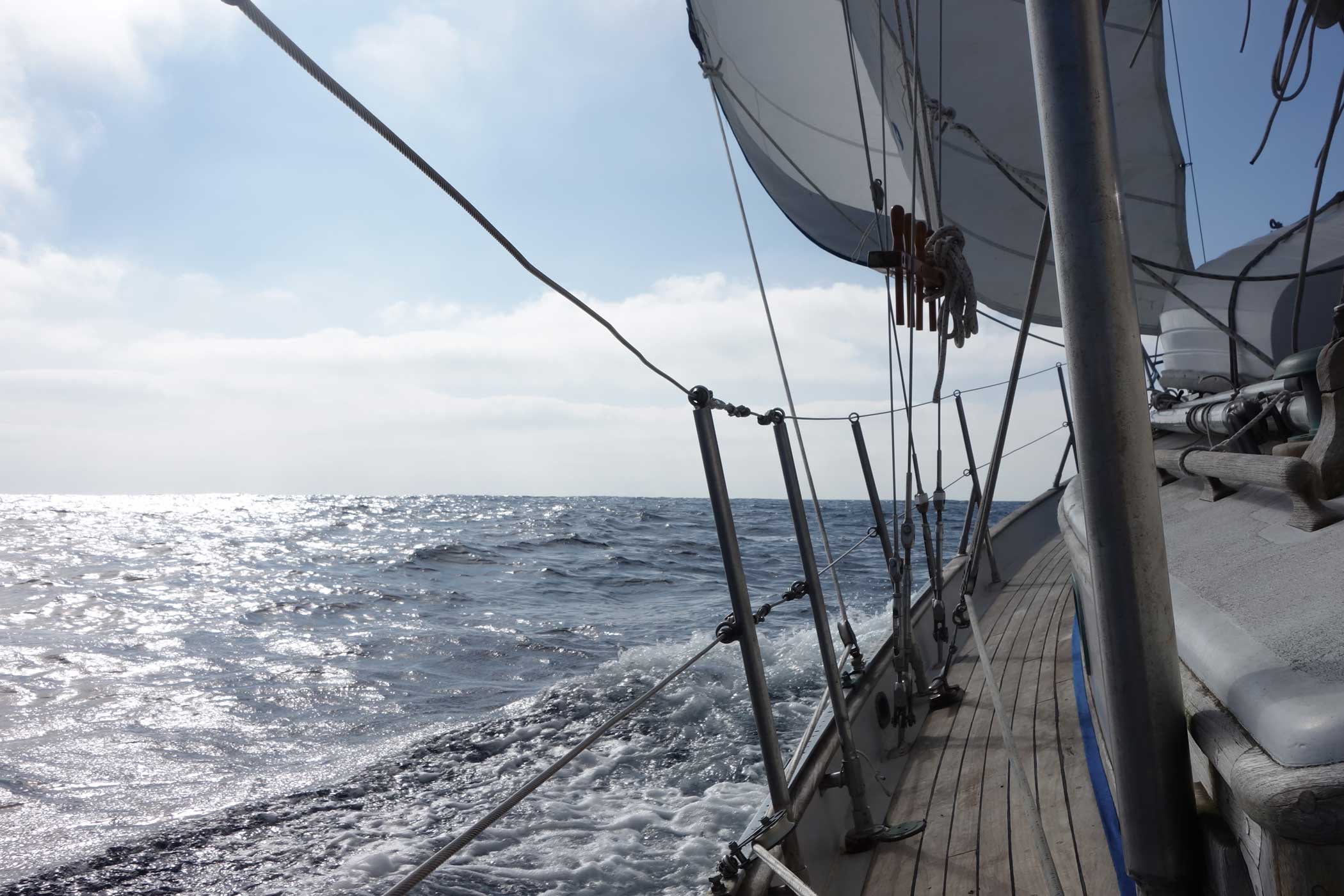
Night and day, Pelican Moon carried all three sails in 13 – 17 knots, smoothly delivering us across the first big “bite” in the Baja peninsula.
When the wind is good enough for sailing, management of the sails takes precedence over managing a fishing rod. Conversely, when there is no wind and we are motoring, we want to get where we are going as quickly as possible so we can turn off the darn engine, and we’re then traveling too fast for proper fishing technique. The constant tension between the two priorities leads to a heightened state of anticipation, for both activities.
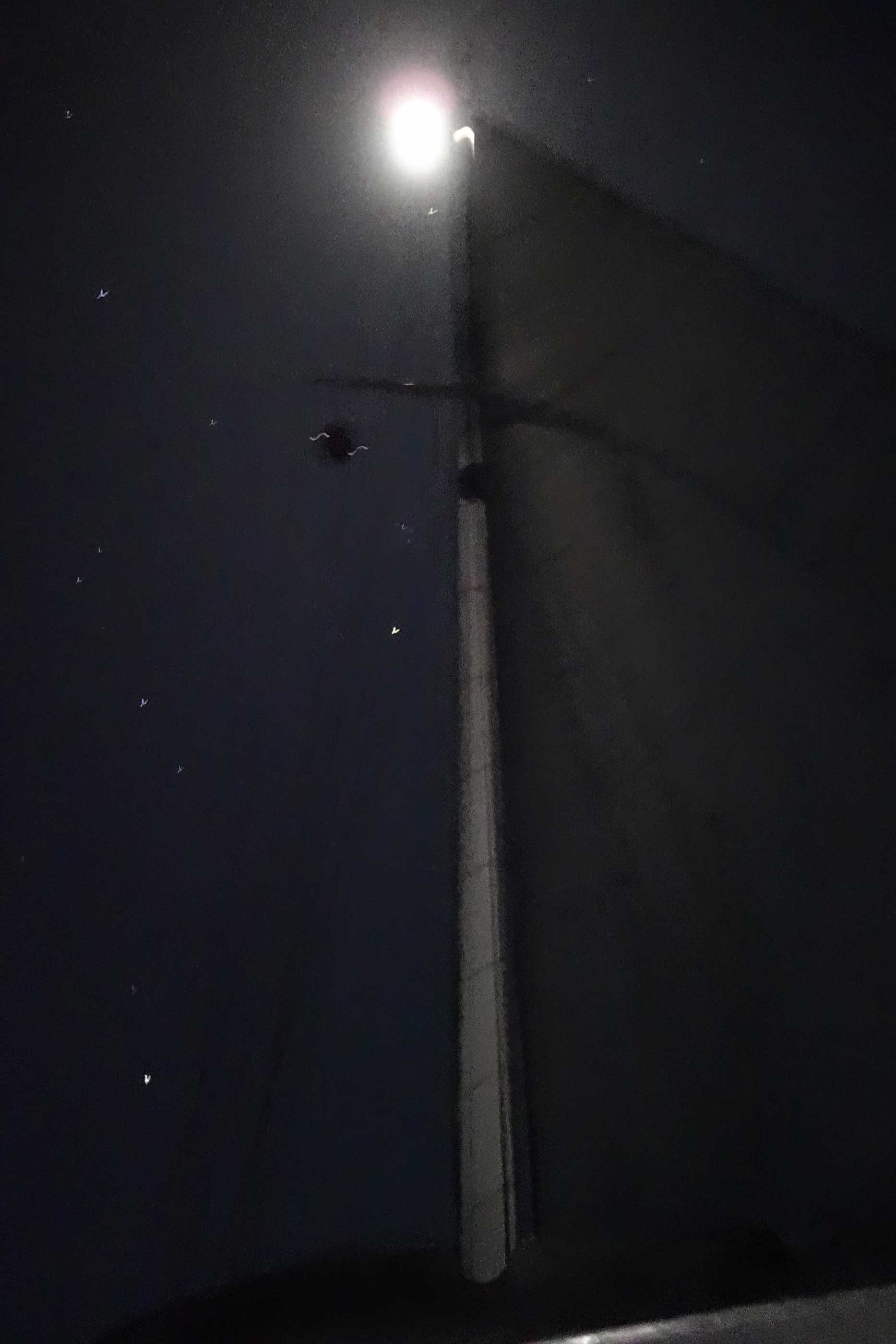
Under sail in the pale moonlight, the ocean is full of possibilities and dreams.
Shortly after dawn on Monday morning the wind dropped and we were flogging along at 1-2 knots. Seeing as we had already enjoyed two straight sunny days and moonlit nights of 10-18 knot winds with all three sails pulling us along at 4-7 knots, rather than start the motor, Wade jumped at this perfect opportunity to get out the fishing gear. Tackle box and large net on the deck, gaff hook balanced on the helm seat, fishing line drawing out behind us, we had only eleven miles to poke along before Turtle Bay, and we were going to have us a fresh fish dinner! Perhaps you can guess where this is headed.

Within 5 minutes, we went from this. . .
Like washing your car brings down the rain, letting out half a reel of fishing line is obviously tossing down a gauntlet to the wind gods. Within two minutes, no more, we were facing sustained 25 – 32 knot winds practically on the nose. With all her sails up (at least the main was still reefed), Pelican Moon heeled over into a hard close reach away from the coast, and all the fishing gear was soon, well, everywhere. Wade ran up forward to drop sails so we could bring in the fishing line, but it was too late for the some of the gear. ‘Bye-bye, line and lure!

. . .to this!!
Soon after we got the sails down, a large fishing trawler came up behind us on the same course, making good speed and closing fast. Blown spray was dousing the dodger windshield, we were still trying to capture all the gear, and the fast-moving boat seemed about to crawl up our lovely stern, so I tried a few radio calls to determine their intentions. Radio silence, except for a friendly cruiser already anchored in Turtle Bay who wanted to know if he could help…? Now under motor, we veered to one side and let the big guy pass. A friendly fisherman on the deck waved.

The pangueros have amazing boat handling skills, and seem to go at two speeds: fast, and breakneck. This one was catching some serious air as we entered Turtle Bay.
Once we turned into the bay, the waves flattened out, but we still had to thread our way around the anchorage, select a spot and drop the hook while 20 – 25 knot winds continued to blow. I sat on the bowsprit platform for a good 45 minutes, watching to see if our anchor dragged. I had entertainment, though. The big fishing boat that passed us by was anchored next door. It’s been interesting to watch the men load and unload tall stacks of traps while balancing precariously in heaving pangas (small fishing boats) tied alongside. We’ve also seen a hilarious mattress fight on deck: seven or eight of them were pushing each other back and forth using a new queen-sized mattress wrapped in plastic as their battering ram.
The winds have continued to blow hard for two and a half days, Santa Ana conditions that prevented us from going ashore until this afternoon. After visiting with crew members from the other 4 boats anchored in the bay who were also finally getting a chance to go ashore, we made a quick walk through the dusty streets of town, around a few guard dogs, and past a gas station where four heavily-armed men stood guarding the four corners of the parking lot while they filled the tank of their jeep. We bought fresh eggs from a kindly man in a tiny tienda who also told us where to find fresh tortillas.

There isn’t much pavement in the town of Turtle Bay, and it’s a pretty dusty place with many small streets that coil around one another, all leading eventually to the main drag. Shacks and falling-down cinder block houses stand next to stuccoed lime-green, pink, yellow, or turquoise houses with gardens and prosperous-looking yard décor. Those well-maintained houses and lots of new trucks driving around tell us that at least some of the people in town are living a comfortable existence. The shrimp canneries closed down in the ‘90s when, like many places around the Baja, local and international overfishing stripped the nearby waters of the primary commodity. Fishing, lobster trapping, and abalone farming are the resource staples of the area now.
Tomorrow we leave for the next anchorage, a small town in the lee of Punta Abreojos (Point Open Eyes). Reviewing the charts, we see that our course places us directly over a couple of seamounts – good places to fish. Looks like we’ll be balancing those two priorities again. Maybe we can find a way to use the fishing to bring the wind when we need it. We’ll let you know how that works out for us!

 sailing pelican moon